Context Atlas
The domain-neutral foundation for anyone who needs controlled context for AI work.
- Local viewer and pack builder
- Shared data contract and templates
- Review, source and correction rules
Product Five | AI context toolkit
A downloadable toolkit that helps you organise the facts, decisions and source files an AI assistant should use for one specific task.
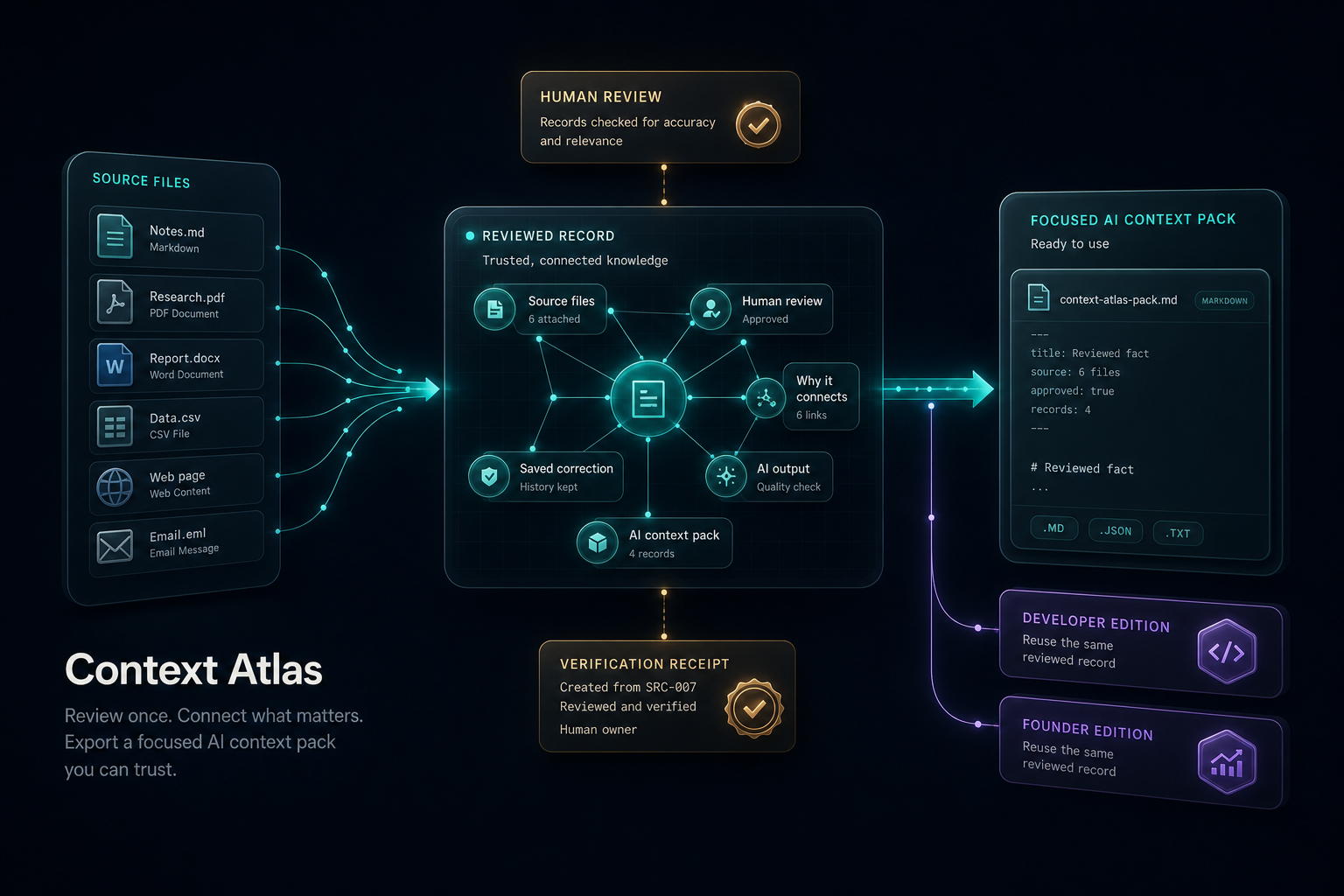
Review information before it reaches the AI, connect related facts, then export a focused Markdown or JSON context pack instead of sharing your entire workspace.
Build a focused AI context pack with its sources, review status and correction history attached.
Runs from the downloaded folder. No hosted account is required.
Interactive example
Use Product 5 and Product 6 together
In this example, six reviewed Product 5 sources become one Product 6 team-invitation pack. Test and migration evidence returns to Product 5 for review.
A practical example
A fictional product team needs an AI assistant to prepare a release-readiness brief. Context Atlas turns reviewed meeting notes, decisions and constraints into one focused context pack for that task.
The meeting note records that the beta date moved after an accessibility review.
Source attachedA human confirms the new date, source quality, confidence and sensitivity before use.
Human approvedFour relevant records are included. Two unrelated records stay outside this task.
Scope recordedThe result is reviewed, corrected if needed and saved with a clear audit receipt.
Correction history keptThe Context Atlas product family
All three use the same review rules, source tracking, typed relationships and portable context-pack format.
The domain-neutral foundation for anyone who needs controlled context for AI work.
Adds repositories, requirements, decisions, issues, tests, builds and releases for coding-agent workflows.
Buyer outcome: an AI project brain for software work.Open the developer product pageAdds company, offers, customers, policies, goals, experiments and campaigns for business-AI workflows.
Buyer outcome: an AI company brain for running the business.Open the founder product pageProducts Six and Seven are separate editions with their own onboarding, examples and buyer outcomes. They do not replace the Product Five foundation.
See what the toolkit includes
1 of 5
Product manifest
Interactive product proof
Walk a fictional source through the shared Product Five lifecycle. This stays in your browser and does not call an AI provider.
CAPTURE 014
The public beta target moved from 28 August to 30 August so the keyboard-navigation fixes can be verified before release.
HUMAN REVIEW
The note remains attached to every object and relationship created from it.
The date is a target, not a confirmed release commitment.
Safe for this fictional workspace; not promoted outside it.
TASK SCOPE
3 included | 1 excluded with a reason
NEUTRAL EXPORT
{
  "contract_version": "0.1",
  "task": "Prepare the release-readiness pass",
  "trust_policy": "reviewed-only",
  "included": ["beta-target", "accessibility-gate", "release-checklist"],
  "excluded": [{ "id": "customer-research", "reason": "not required for this task" }],
  "adapter": { "target": "neutral-files", "status": "local export only" }
}Markdown + JSON are the current neutral path. ChaseOS and other runtimes remain untested adapter declarations.
OUTPUT VERIFICATION
“Northstar Launch will release publicly on 30 August after the accessibility work is complete.”
The source says 30 August is a target, not a confirmed public release date. “Will release” overstates the reviewed evidence.
HUMAN CORRECTION
PROOF RECEIPT
No project truth changed.
One source and three typed links retained.
3 objects included; exclusions recorded.
The draft overstated a target as a commitment.
Target remains conditional on keyboard-navigation verification.
What is included
Purchaser delivery contract
Version 1.0 is a working local toolkit. These are the exact deliverable groups in the customer ZIP and the job each one performs.
viewer/index.htmlInspect the graph, review records, scope one task and export JSON or Markdown without a hosted account.
contract/context-atlas-core.schema.jsonKeep sources, objects, typed relationships, review history and context packs in inspectable JSON.
tools/context-atlas.mjsCreate, inspect, validate and export workspaces repeatably with Node.js 20 or newer.
templates/Start from explicit workspace, record, relationship, review, pack, profile and adapter structures.
examples/Learn from the neutral walkthrough and see how the Developer and Founder editions reuse the same core.
results/neutral-launch/Open the exact Markdown and JSON pack produced by the example before creating anything yourself.
profiles/Extend the vocabulary for Products 6 and 7 without weakening the shared trust contract.
adapters/ + docs/USING-WITH-OTHER-SYSTEMS.mdUse tested neutral files with assistants, agents, graphs and automation while keeping untested paths explicit.
manual/context-atlas-guide.pdfFollow the trust loop, viewer, CLI, privacy rules, family boundaries and troubleshooting visually.
manifest.json + PROOF-REPORT.mdVerify every buyer file, package claim, limitation and the exact Version 1.0 archive identity.
Actual result included
The included Northstar example turns a reviewed workspace into one release-readiness pack. The same result is delivered as readable Markdown and structured JSON.
UncertaintyNo production deployment or buyer acceptance has been tested.
ExcludedCustomer research is left out because it is not needed for this task.
Use it with other systems
Context Atlas does not require one AI provider or graph platform. Export a bounded Markdown or JSON pack, then use only the capabilities the receiving system has actually demonstrated.
Attach the Markdown pack to one task. The assistant receives reviewed facts, sources, constraints, uncertainty and exclusions instead of a full data dump.
Place a task-sized pack in the agent's approved work folder. Product Six adds developer records, onboarding, fixtures and tested coding-agent recipes.
Export only the company context needed for the task. Product Seven adds founder records, onboarding, fixtures and business-specific recipes.
Map nodes and typed edges while preserving stable IDs, sources, trust state, sensitivity, confidence and dates. Declare any fields the target drops.
Validate before use, fail closed on broken references, and retain the workspace and task pack as ordinary files when the sensitivity allows it.
Use the included architecture-fit declaration as an education path only. A tested ChaseOS or Studio adapter is not included in Version 1.0.
Products Six and Seven extend this same foundation. They add distinct onboarding, records, examples, screenshots, recipes, exporters and buyer outcomes. They are not folders renamed from Product Five.
Current build
Version 1.0.0 | Contract v0.1How the system works
The Developer and Founder editions change the records, examples and buyer outcome. The review process and portable export format stay consistent.
Bring in a source, then decide whether its facts are trusted, need correction or should stay out of the workspace.
Record why a source supports a decision, constraint, goal or other piece of useful context.
Export only the reviewed facts needed for one task, with sources, exclusions and limits included.
Review the AI output, save any correction with a receipt, then expire or archive stale information.
Interoperability contract
Neutral files work first. The buyer guide shows practical use with assistants, coding agents, business AI, graphs and automation. A named integration becomes compatible only after its exact target and capabilities are tested.
The CLI and local viewer create inspectable task packs without a hosted service or ChaseOS dependency.
Neutral, Developer and Founder examples pass the shared checks with zero dangling edge, source, review or context-pack references.
The governed-system path is educational until a versioned adapter and direct acceptance evidence exist.
No universal compatibility claim is made. Each target needs its own tested adapter declaration.
Build evidence
The local product and buyer archive demonstrate capture, human review, graph connection, focused export, correction and audit history with fictional public-safe data. The clean-extracted package passes its declared file, validation and adapter paths. Named external runtime execution, paid-buyer delivery and customer outcomes remain separate proof states.
Try the guided context-pack example →Before you buy
No. The shared core is built around reviewed objects, typed relationships, provenance, task-sized exports and correction receipts rather than collecting everything into an undifferentiated archive.
No. Product Five is standalone and local-first. ChaseOS can become an optional governed-system adapter after direct, versioned testing; it is not a hidden dependency.
No. They are profile layers. The core keeps object types open so later editions can own their own fixtures, onboarding, exporters and buyer outcomes.
No. It demonstrates the context governance path using fictional local data. Real runtime execution and output verification require separate adapter evidence.
Yes through the tested neutral file path when the tool accepts Markdown or JSON. Start with one task-sized pack and verify the output. Named tool compatibility, automatic import and writeback require their own tested adapter evidence.
Need this operating knowledge applied to your own system?
See ChaseInTech services →No matches