Build log
Inside LaunchReady: making 111 launch checks easy to navigate
How a 111-deliverable release system was made navigable for agentic builders while keeping the design, executable harness, publication and buyer-delivery proof states separate.
Source: Public Product 4 design foundation, deterministic navigation media and ChaseInTech production integration evidence
Technical bibliography record
The build, in five parts.
- 01 Built
- A production Product 4 page with a 72-second captioned navigation film, six interactive visual chapters, responsive media and an explicit 111-deliverable architecture.
- 02 Process
- The approved identity was corrected at the deterministic media source, regenerated, compressed for the web, integrated through the existing product system and reviewed at desktop and mobile widths.
- 03 Learned
- A large handover becomes usable when it follows the decision journey and shows proof boundaries before buyers encounter the underlying files.
- 04 Skills
- release-system designvisual QAAstroresponsive mediaPlaywright
- 05 Saved
- Versioned product data, responsive image variants, captions, film, navigation frames, browser assertions and an honest implementation-status record.
Visual QA and product evidence
See the milestone, not only the summary.
Exactly what was designed#
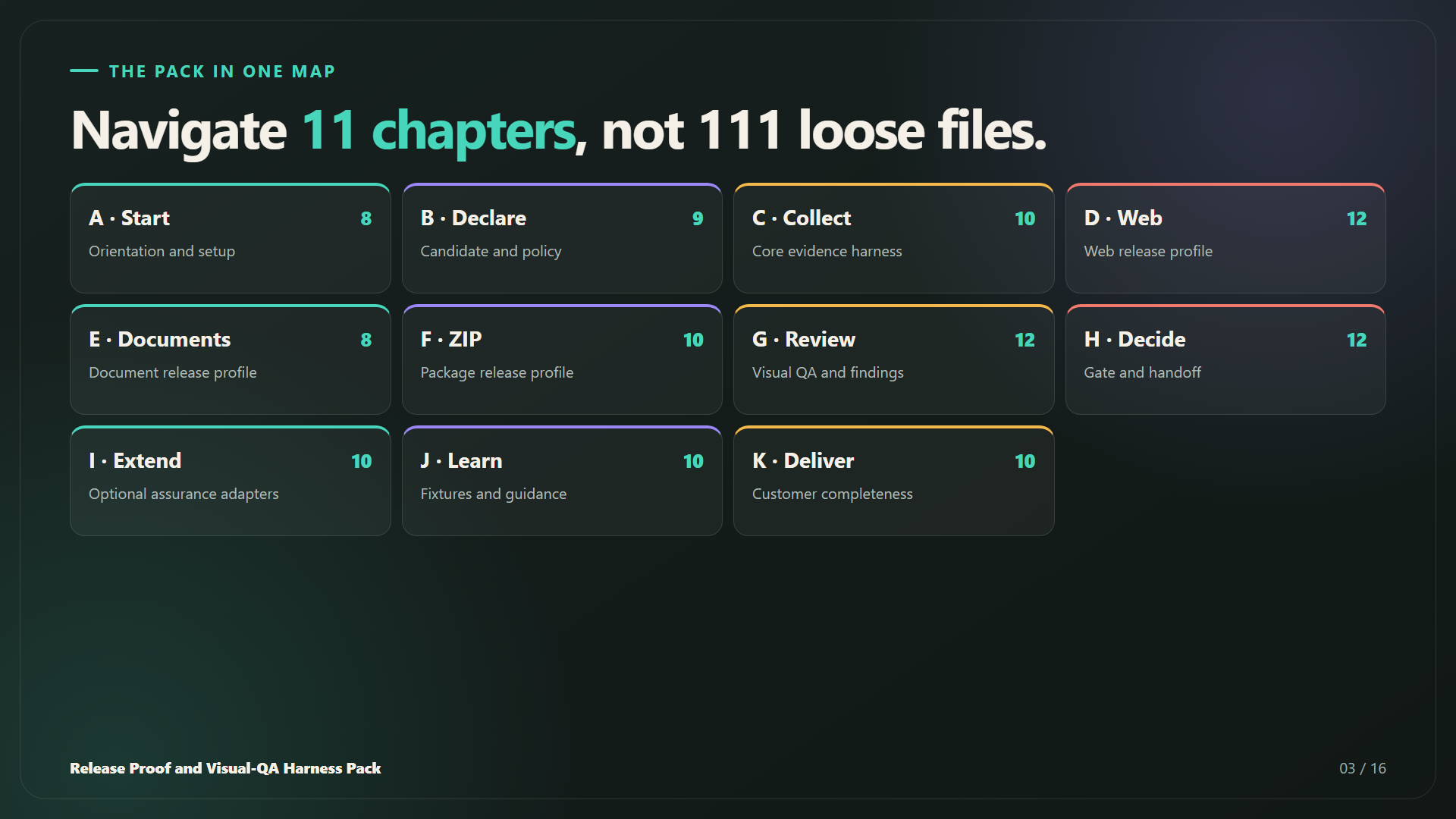
The pack is organized into eleven chapters covering orientation, candidate declaration, core evidence collection, web, document and ZIP profiles, visual review, release decision, optional assurance, fixtures and customer delivery. Those chapter counts total 111 mapped deliverables, but the public milestone is deliberately labelled as a design foundation rather than a finished executable toolkit.
Keep proof states separate#
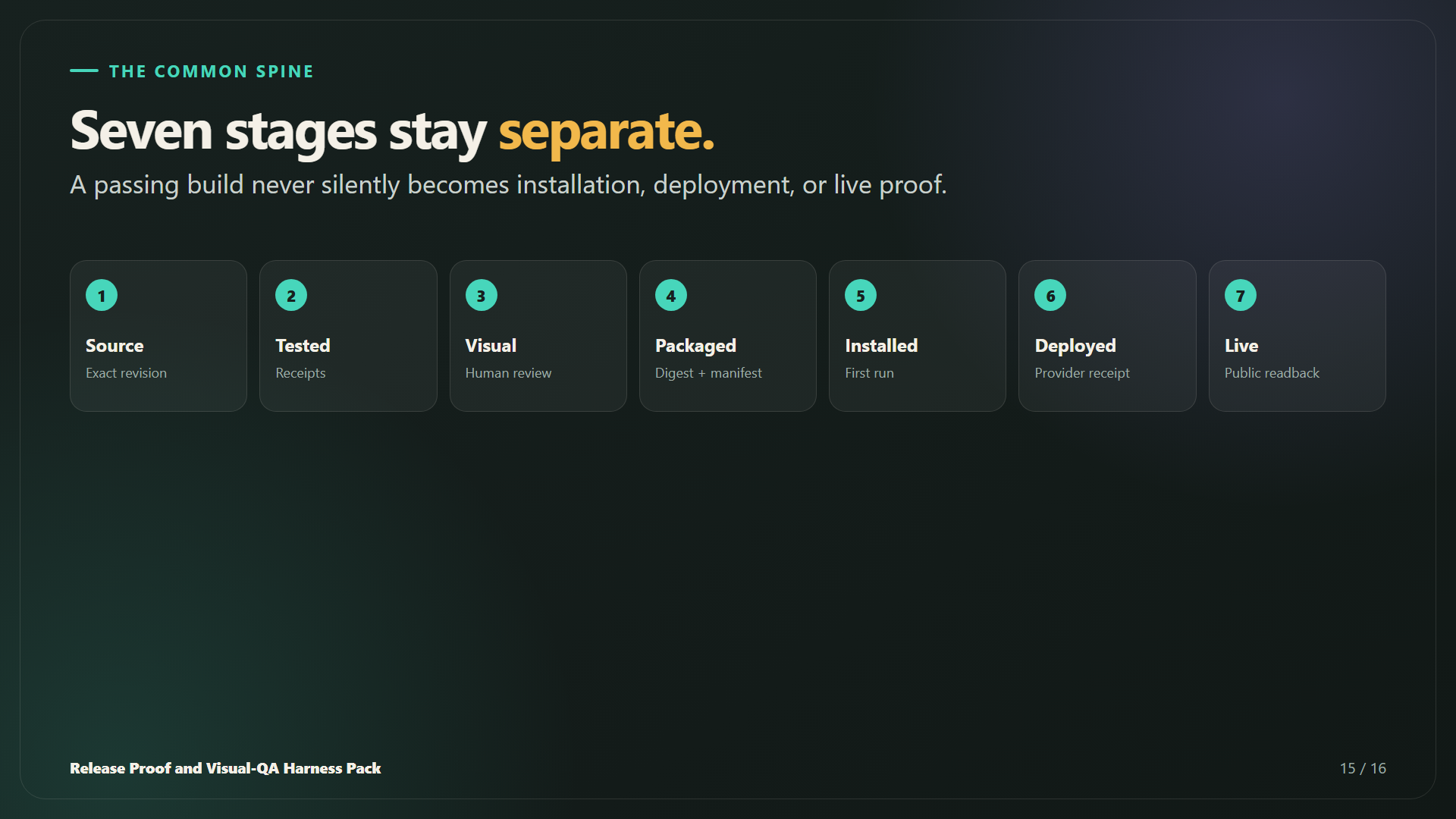
The current evidence proves the product architecture, deterministic media output, responsive page integration and local browser behaviour. It does not prove an executable harness, customer ZIP, checkout, deployment through a buyer workflow or customer acceptance. Those claims remain visibly marked as in development or not released.
What remains human-owned#
Automation can bind evidence to a candidate, run checks, capture renders and assemble a decision bundle. A person still sets acceptable risk, resolves ambiguous findings, reviews accessibility and visual quality, accepts exceptions and authorizes any production action.
What was saved#
The durable output includes the approved product identity, media source, deterministic renderer, 1920 by 1080 navigation frames, an optimized 1280 by 720 H.264 film, English captions, responsive WebP derivatives, product-page content and focused browser tests. The buying route remains intentionally absent until the executable customer release earns its own proof.