Build log
ChaseOS: turning build activity into native working knowledge
How build logs, runtime activity, evidence and reviewed lessons stay distinct—then become useful context for future agent work without silently becoming truth.
Journey 2026-03-20 → 2026-07-13
Source: Public ChaseOS Core architecture and privacy-screened Build Log, Agent Activity and provenance doctrine
Technical bibliography record
The build, in five parts.
- 01 Built
- A typed evidence loop separating development history, runtime activity, audit events, candidate lessons and reviewed knowledge.
- 02 Process
- Outputs are routed by artifact type, linked to sources, screened for private material and promoted only through an explicit review boundary.
- 03 Learned
- An activity feed is not memory, visibility is not authority, and a useful knowledge system must preserve why a record exists as well as what it says.
- 04 Skills
- knowledge architectureprovenanceagent memoryaudit designretrieval systems
- 05 Saved
- Build records, activity receipts, source links, review states, reusable lessons and indexes that future runtimes can query without rewriting history.
Visual QA and product evidence
See the milestone, not only the summary.
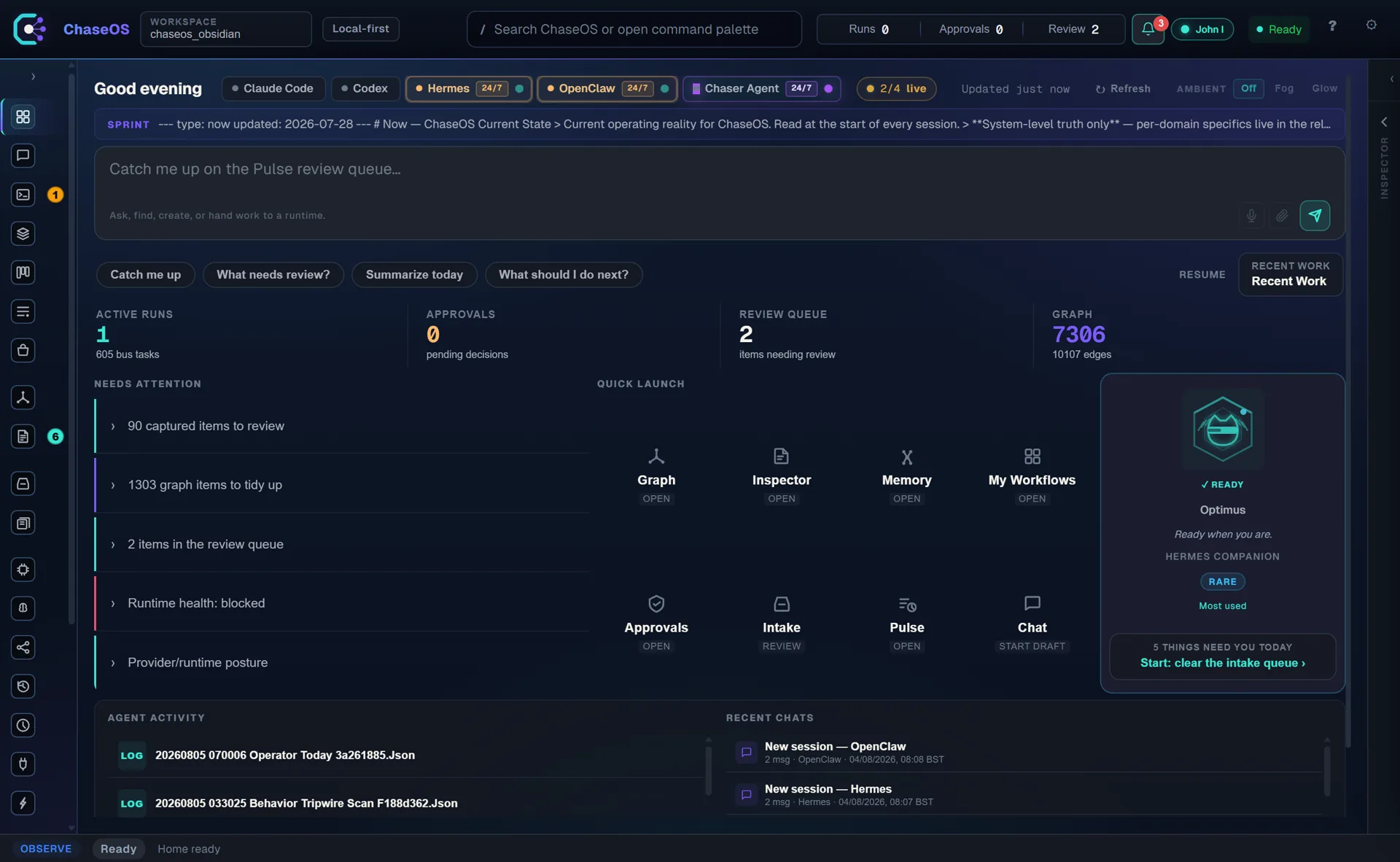
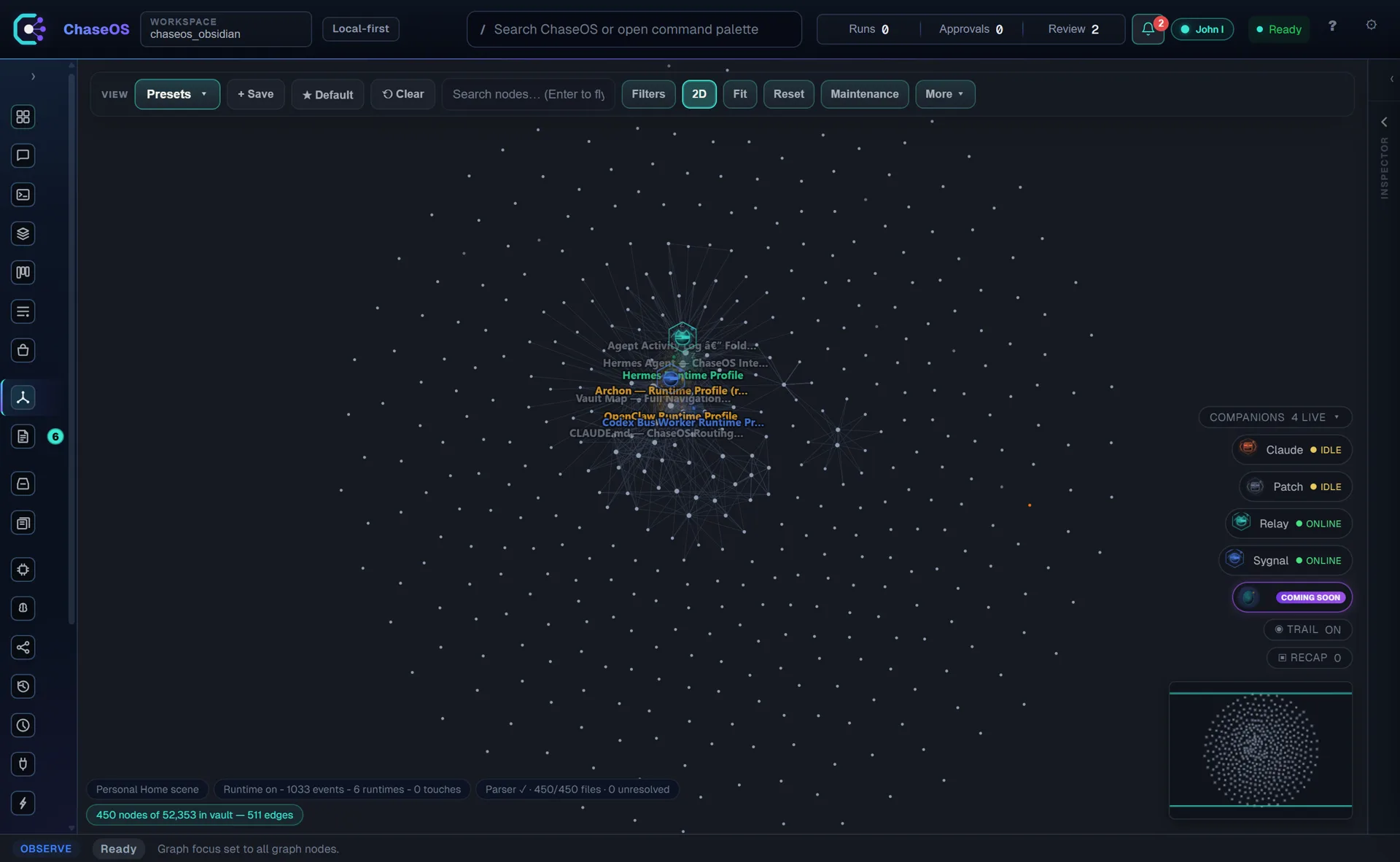
Exactly what was built#
ChaseOS keeps several histories deliberately separate. Build Logs record development and release work. Agent Activity records non-build runtime and audit-significant actions. Runtime events describe execution traces. Provenance links artifacts back to their sources. Candidate lessons can be reviewed for durable reuse, while canonical knowledge remains behind its own promotion gate. The result is a system that can remember progress without flattening every event into one unreliable feed.
The process#
A meaningful task closes with source changes, tests, visual or runtime evidence where relevant, a build record and an activity receipt. Public projection requires an additional privacy and claim screen. Reusable lessons retain their source references and status before a person decides whether they belong in durable knowledge. Future harnesses retrieve the typed result through the same bounded context layer instead of scraping a chat transcript and guessing what mattered.
What we learned#
The useful distinction is not simply recent versus old. It is what happened, what is true now, what requires review, what was learned and what has authority. Keeping those meanings separate makes the history more useful to people and safer for agents. A future runtime can reuse a release lesson without inheriting the original task's permissions or assuming an old deployment is still current.
Skills gained#
This work developed practical skill in provenance modelling, trust-aware retrieval, agent-memory boundaries, audit/event taxonomy, knowledge-graph design, artifact routing and human-governed promotion workflows.
What was saved#
The system retains linked development records, runtime receipts, approval context, test evidence, source references and reviewed lessons. It does not retain credentials, hidden model reasoning or private customer state in public projections, and it does not treat a visible record as automatic canonical truth.
How future harnesses use it#
A future agent can ask what failed in the last updater release, which visual-QA rule caught a mobile defect or why a particular authority boundary exists, then receive a source-linked answer from the native knowledge layer. The harness gains context, not permission: execution, publication and canonical writeback remain separately governed.