Build log
MarginFlip: separating business performance from market research
Why a reseller's measured business performance and external market research needed different routes, data meanings and proof standards.
Journey 2026-08-20 → 2026-08-24
Source: Public MarginFlip product surface and privacy-screened architecture, test and commercial-boundary records
Technical bibliography record
The build, in five parts.
- 01 Built
- A locally verified navigation and information architecture separating measured performance from external reseller and ecommerce research.
- 02 Process
- The product was audited against real workflows, competitor surfaces and repository truth before routes, aliases and responsive decision views were changed.
- 03 Learned
- An attractive dashboard becomes misleading when owned business facts and external market signals share one undifferentiated intelligence label.
- 04 Skills
- product architecturecommerce analyticsReactresponsive dashboardscommercial boundaries
- 05 Saved
- Route contracts, tests, architecture decisions, truthful claim limits and the unresolved deployment and provider gates.
Visual QA and product evidence
See the milestone, not only the summary.

Exactly what was built#
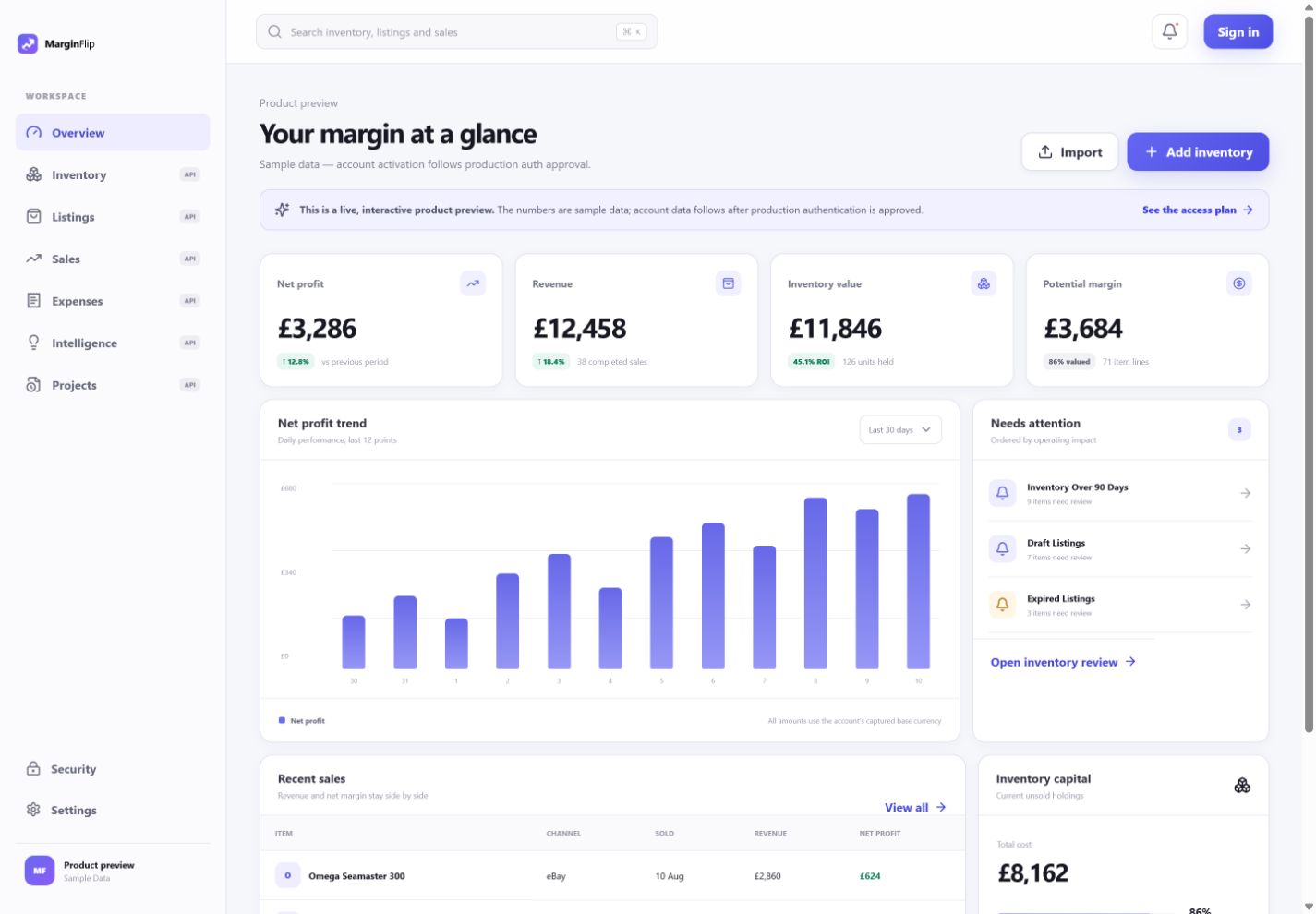
MarginFlip's locally verified product architecture now gives measured Business Performance and external Market Research separate homes. Performance is grounded in the operator's inventory, listings, sales and expenses. Market Research is reserved for reseller and ecommerce observations whose freshness, source and uncertainty differ from first-party business records. Existing legacy paths remain aliases rather than breaking old navigation.
The process#
The work started with the sign-in, onboarding, dashboard and navigation behavior already present in source, then compared focused competitor surfaces panel by panel. Route ownership, labels and information hierarchy were changed only after identifying which data each surface could truthfully claim. Tests, type checks and the production build were run in an isolated workspace; deployment and provider configuration remained separate gates.
What we learned#
The word intelligence was doing too much work. A seller's own margin trend is measured operational truth; an external sourcing signal is research. Combining them weakens both. The same distinction applies commercially: billing foundations, webhook routes and pricing plans are not live subscriptions until provider configuration, checkout and entitlement projection have been verified.
Skills gained#
The pass strengthened product information architecture, reseller operations modelling, responsive analytical UI, auth-state diagnosis, competitive workflow review, entitlements design and truthful commercial-state communication.
What was saved#
The retained artifacts include the route and navigation contract, focused tests, build evidence, commercial boundary documentation and a claim ledger separating live product behavior from local billing foundations, planned research connections and unverified external operations.
Into the knowledge loop#
The reusable product lesson is stored independently of MarginFlip's private operational data: first-party performance and third-party research need different provenance, freshness and confidence semantics. Future dashboard or lab-tool harnesses can reuse that architecture without inheriting customer data or assuming a connector is live.