Build log
LaunchReady: checking a vibe-built app before real users arrive
How Product 4 became a working app launch check kit, a prominent commercial walkthrough, and a live £59 buying route without pretending a public listing proves paid-buyer delivery.
Source: Public Version 1 product source, synthetic acceptance fixtures, deterministic package record and verified Payhip listing
Technical bibliography record
The build, in five parts.
- 01 Built
- An executable local CLI, Playwright Web profile, ZIP and Document starters, Evidence Workbench, synthetic broken/corrected fixture pair, human HOLD gate and deterministic Individual customer archive.
- 02 Process
- The design foundation was converted into candidate-bound collection, responsive evidence, exception-first review, separate corrected lineage and a reproducible customer package before the public Payhip route was created.
- 03 Learned
- Vibe coding becomes production-useful when speed is followed by a visible proof contract: declare the exact candidate, collect bounded evidence, review the render, improve, re-test and let a person decide.
- 04 Skills
- Node.js CLI designPlaywrightvisual QAdeterministic packagingstorefront release
- 05 Saved
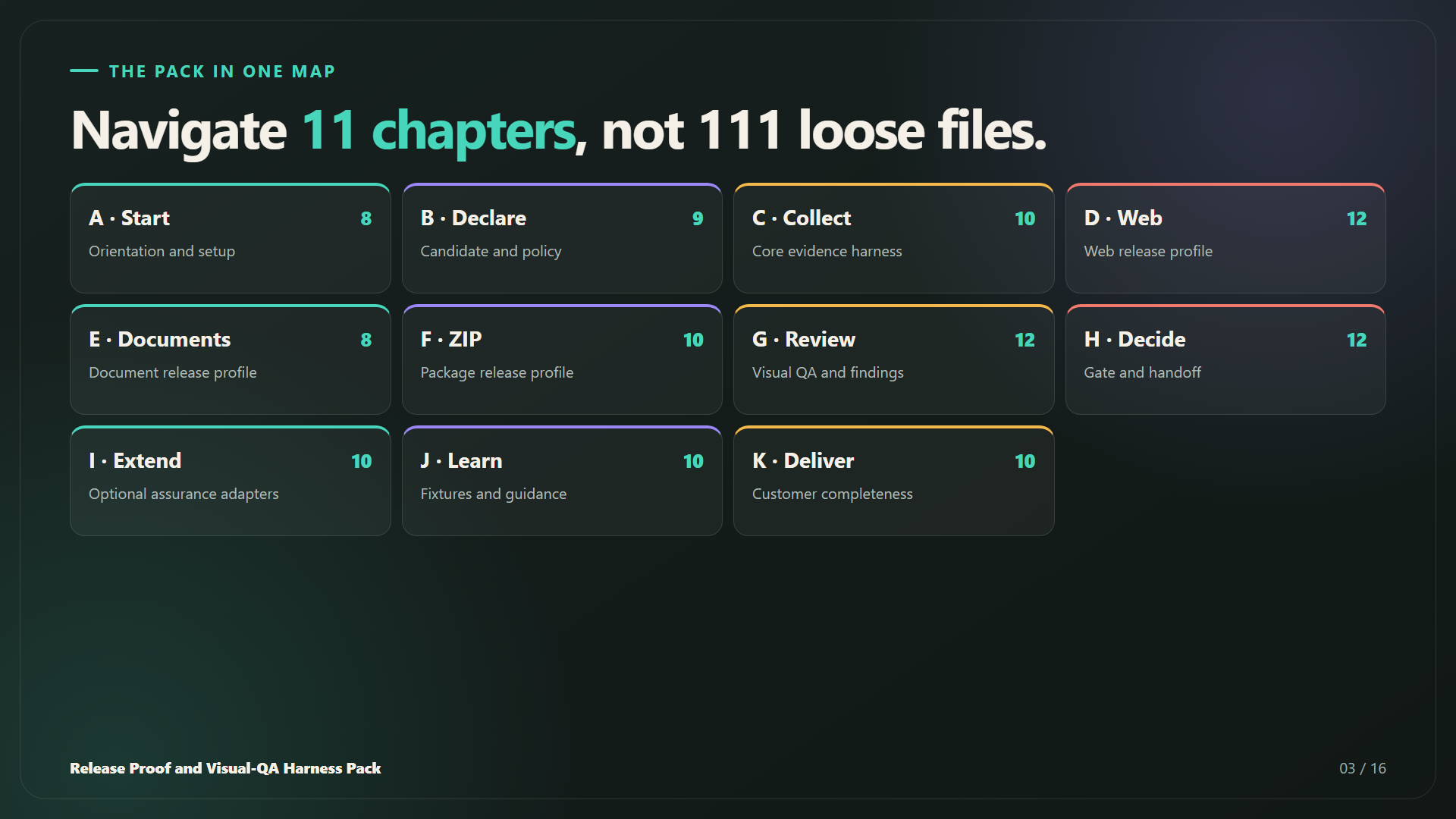
- Version 1 source, tests, schemas, fixtures, reports, 40-second commercial introduction, 72-second technical navigation film, square thumbnail, package manifest, checksum, licence, support boundary and public storefront record.
Visual QA and product evidence
See the milestone, not only the summary.
The real buyer journey#
The audience is not merely developers who need another checklist. It is agentic engineers, vibe coders, agentic developers and technical founders who can get an application working quickly but still need to know what exact candidate was tested, what the buyer-facing render looked like and which release claims remain unverified.
What Version 1 actually runs#
The local CLI declares a candidate, captures desktop, tablet and mobile Chromium screenshots, records HTTP, console, failed-request and overflow signals, preserves command receipts, extracts and inventories ZIP packages, hashes artifacts, scans readable files for high-risk privacy patterns and exports JSON, Markdown, raw evidence and a printable HTML Evidence Workbench.
Review, label, improve, re-test#
The included Signal Shop pair has an intentional console error and mobile overflow in one candidate and a corrected state in another. Acceptance requires the broken candidate to produce findings, the corrected candidate to remain separate and every automated run to stop at a human HOLD gate until the screenshots are reviewed.
Lead with a real commercial introduction#
A 40-second captioned commercial is open by default near the start of the product page. It uses customer-facing language and a simple visual journey from buyer uncertainty to human-owned release confidence. The detailed 72-second technical navigation film remains inside the customer download, while the interactive frames, manifest, compatibility evidence and buying section stay available underneath.
Commercial truth#
Version 1 is publicly listed on Payhip and Ko-fi at a £59 launch price. Both public pages expose a buying action and declare the customer ZIP, establishing two live buying routes. No paid order was placed during launch QA, so paid-buyer delivery, revenue and customer acceptance remain explicitly unverified.