Founder decision brief
founder-decision-brief.mdRecords the question, approved facts, chosen action, owner, rationale and what remains unauthorised.
Product Seven | £19 AI company-brain add-on
A £19 founder decision layer for Product 5 that turns reviewed company evidence into one choice, one bounded agent workflow, one 30-day test and six usable files.
Use Product 5 to approve the facts. Use Product 7 to compare options, record the founder decision and return measured evidence.
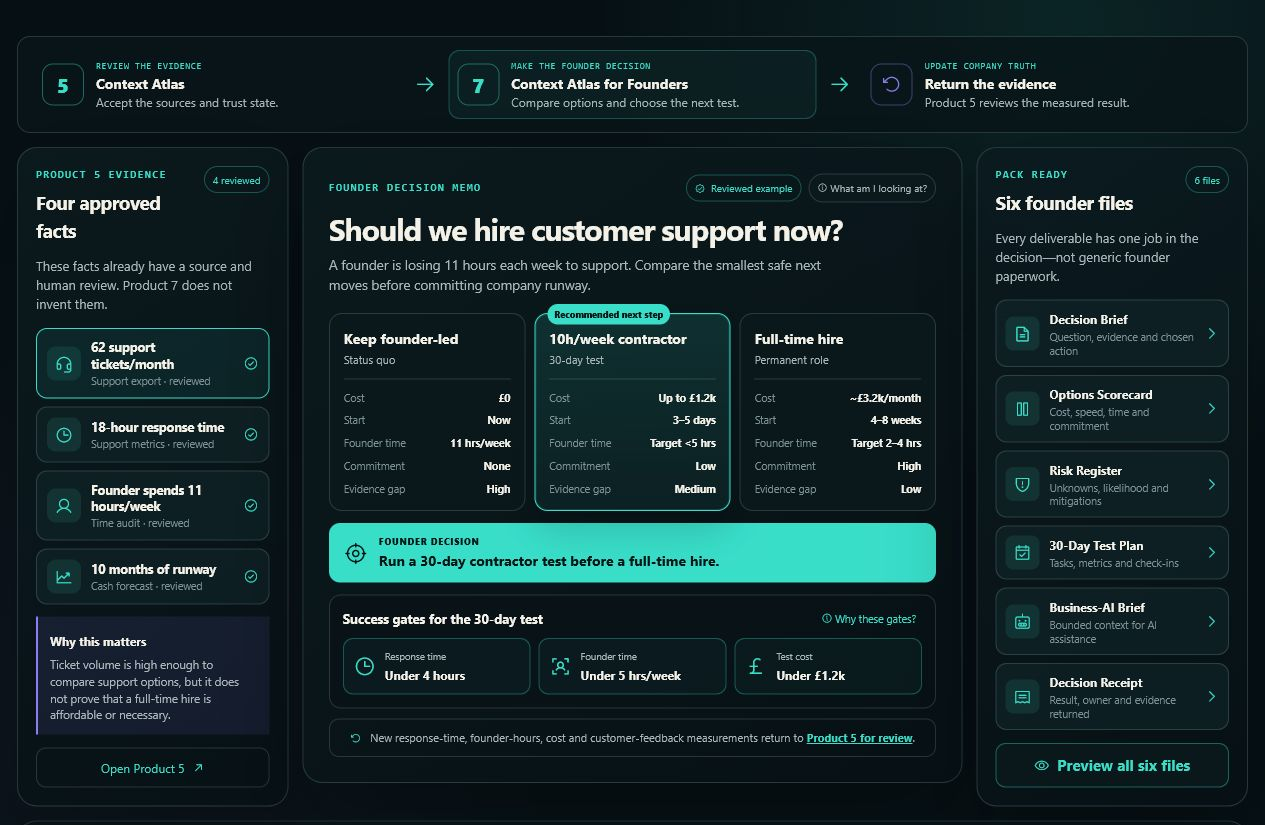
The worked example answers a practical founder question: test a support contractor for 30 days before committing to a full-time hire.
Runs from the downloaded folder. No hosted account is required.
Use Product 5 and Product 7 together
Product 5 approves the support volume, response time, founder time and runway facts. Product 7 compares three options, records a 30-day contractor test, assigns three bounded agent-harness tasks, sets £0 autonomous agent spend and returns the measured result.
Plain-English guide
Product 5 supplies the reviewed baseline. Product 7 compares the real options, records the founder-owned choice, defines the 30-day test and packages bounded tasks for people or agent harnesses.
Files passed through the workflow: Product 5 sources → six-file founder decision pack → decision receipt.
What is included
Paid edition deliverable preview
The public demo shows the structure and purpose of all six paid files without giving away the buyer ZIP.
founder-decision-brief.mdRecords the question, approved facts, chosen action, owner, rationale and what remains unauthorised.
options-scorecard.mdCompares founder-led support, a contractor test and a full-time hire across the same five criteria.
risk-register.mdNames the assumptions, failure modes, mitigations and evidence request behind the decision.
thirty-day-test-plan.mdDefines the weekly tasks, success gates, measurements and day-30 review.
agent-harness-task-packet.jsonDefines evidence, planning and verification roles with explicit permissions, stop conditions and founder approval gates.
decision-receipt.mdCaptures the measured result and proposes source-linked updates back to Product 5.
Actual result included
Support is consuming 11 founder hours per week, but 10 months of runway makes a permanent hire risky. Product 7 compares three options and chooses the smallest test that can return evidence.
UncertaintyThe contractor may not return six founder hours or maintain response quality.
ExcludedNo hiring, candidate outreach, employment offer, uncapped spend, publication or software work is authorised.
Context proof, not memory theatre
Start in Context Atlas with reviewed company sources. Open one founder question here, compare the real options, export six decision files, then return the measured result to Context Atlas for review.
Foundation evidence
Product 7 turns four reviewed Product 5 facts into a three-option comparison, a reversible 30-day decision and a measurable evidence return.
Product 5 + Product 7 workflow
The founder pack carries reviewed truth into one decision. Response time, founder hours, cost, quality and customer feedback come back as proposed evidence—not automatic company truth.
Accept the four company facts and preserve the source and human review behind each one.
Score three options across cost, speed, founder time, commitment and evidence gaps.
Route evidence, planning and verification packets to subscribed agent harnesses without transferring founder authority.
Measure response time, founder time, cost, support quality and customer feedback for 30 days.
Review the decision receipt before accepted company truth or the next hiring decision changes.
Portable by capability
Compatibility language is intentionally exact: mapped architecture is not presented as live acceptance.
All six founder deliverables are readable without a graph tool or technical setup.
The buyer-mode viewer creates an inspectable ZIP locally. The public demo previews the files without releasing that ZIP.
The JSON packet declares three roles, allowed reads and writes, stop conditions, expected results and founder approvals without depending on one vendor.
The example follows public ChaseOS Core task-packet, role-scope, approval-gate and evidence-receipt concepts. Private-instance integration remains separate and unverified.
Interactive product preview
Choose a guided step, then click the preview itself to open the complete working Product 7 workspace. Use the secondary still-image control only when you want to inspect one frame.
Questions before the preview
Product 5 is the reusable evidence foundation. Product 7 is a smaller founder decision layer that depends on that foundation, so its launch price is deliberately lower.
Product 5 reviews sources and trust states. Product 7 compares options, records one founder decision, defines the test and exports six decision-specific files.
No. Product 6 is optional and only receives a bounded task if the founder later authorises software work.
No. The pack explicitly prohibits hiring, candidate outreach, employment offers and spend unless a human separately authorises them.
Product 7 treats each agent harness as a bounded worker. The included task packet gives the evidence analyst, operations planner and verification harness separate permissions and expected results. A subscription provides access to the worker; the founder still owns every protected decision.
No. The example uses public ChaseOS Core concepts—task packets, role scope, approval gates, handoffs and evidence receipts—without reading private company state or claiming a tested private adapter.
No. The support counts, runway and costs are fictional worked data. The decision workflow is the product; the example is not a customer-result claim.
Yes. The demo uses a readable decision memo, option cards and plain-English file previews. No graph interpretation or coding is required.
Need this operating knowledge applied to your own system?
See ChaseInTech services →No matches