Start here
README.mdTeaches the Product 5 → Product 6 → implementation → Product 5 evidence loop and how to use every file.
Product Six | Free developer change-impact toolkit
A free, worked developer edition that turns reviewed project sources into a cross-stack task a developer or coding agent can actually use.
Review the project in Product 5, trace one approved feature in Product 6, export six implementation files, then return the proof for review.
Inspect the source, trust state and project relationship behind every record before it guides a coding task.
Runs from the downloaded folder. No hosted account is required.
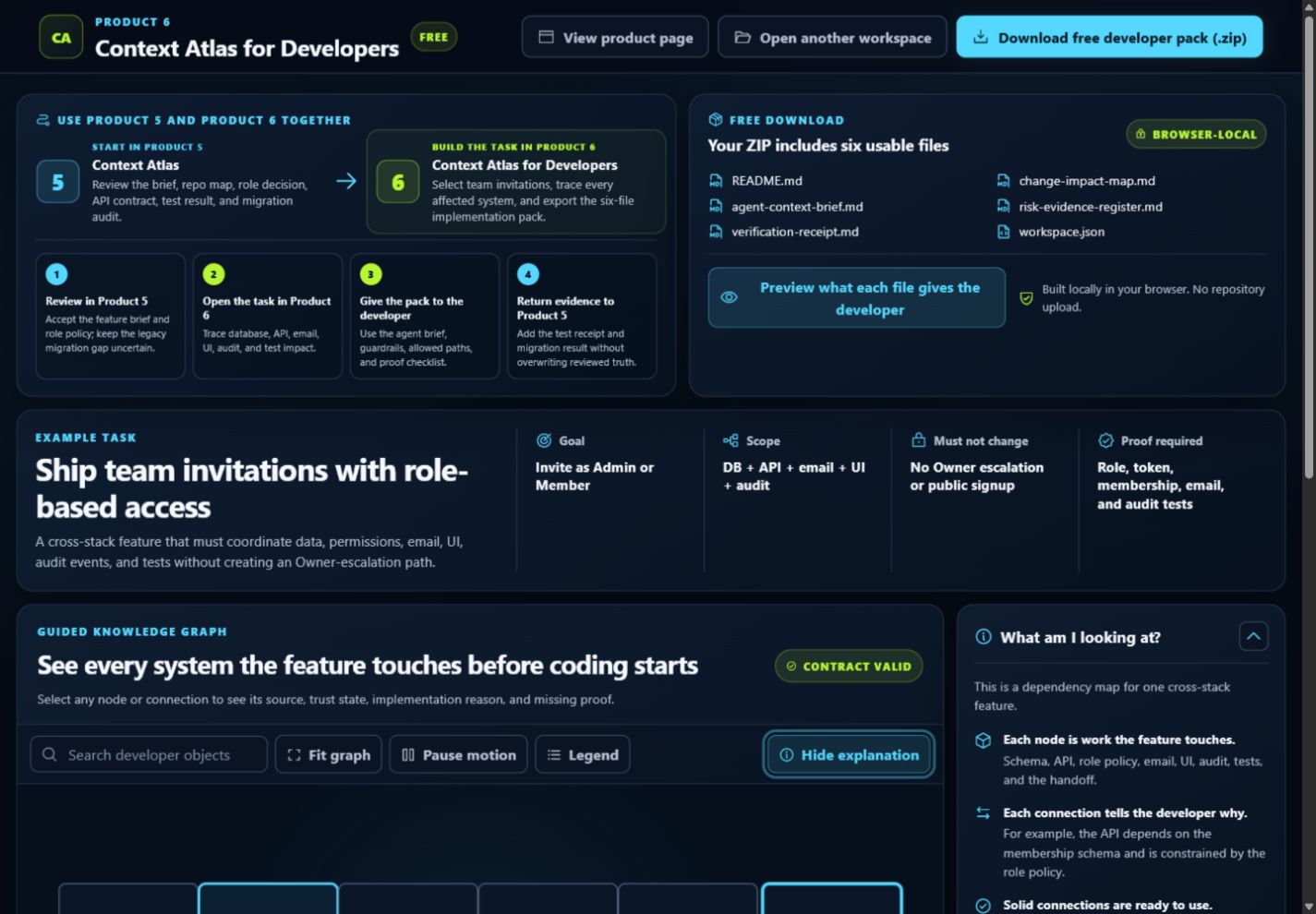
Use Product 5 and Product 6 together
In this example, six reviewed Product 5 sources become one Product 6 team-invitation pack. Test and migration evidence returns to Product 5 for review.
Plain-English guide
For the team-invitation example, Product 5 holds six reviewed sources. Product 6 selects the approved feature, traces the systems it touches, and creates a bounded pack for implementation. Test and migration evidence then goes back to Product 5 for review.
Files passed between the products: workspace.json → agent-context-brief.md → verification-receipt.md.
What is included
Free download manifest
These are the exact six files generated by the guided example and the job each one performs.
README.mdTeaches the Product 5 → Product 6 → implementation → Product 5 evidence loop and how to use every file.
change-impact-map.mdLists the selected cross-stack path, role and token guardrails, side effects and unresolved migration branch.
agent-context-brief.mdCarries allowed paths, role rules, forbidden actions, reviewed sources and required tests into implementation.
risk-evidence-register.mdSeparates reviewed guardrails and local test evidence from the missing legacy-workspace migration proof.
verification-receipt.mdStates what was checked, what passed and what the example does not claim.
workspace.jsonProvides source-linked nodes, edges and trust states for people, agents and graph-capable systems.
Actual result included
Instead of telling an agent to 'add invitations', the pack names every affected system, authority rule, side effect, forbidden action and proof requirement.
UncertaintyLegacy workspaces still require a counted membership migration and backfill receipt.
ExcludedNo deployment, release or production result is claimed.
Context proof, not memory theatre
Start in Context Atlas with six reviewed sources. Open one approved feature here, trace every affected system, export the implementation pack, then return the test and migration evidence to Context Atlas for review.
Foundation evidence
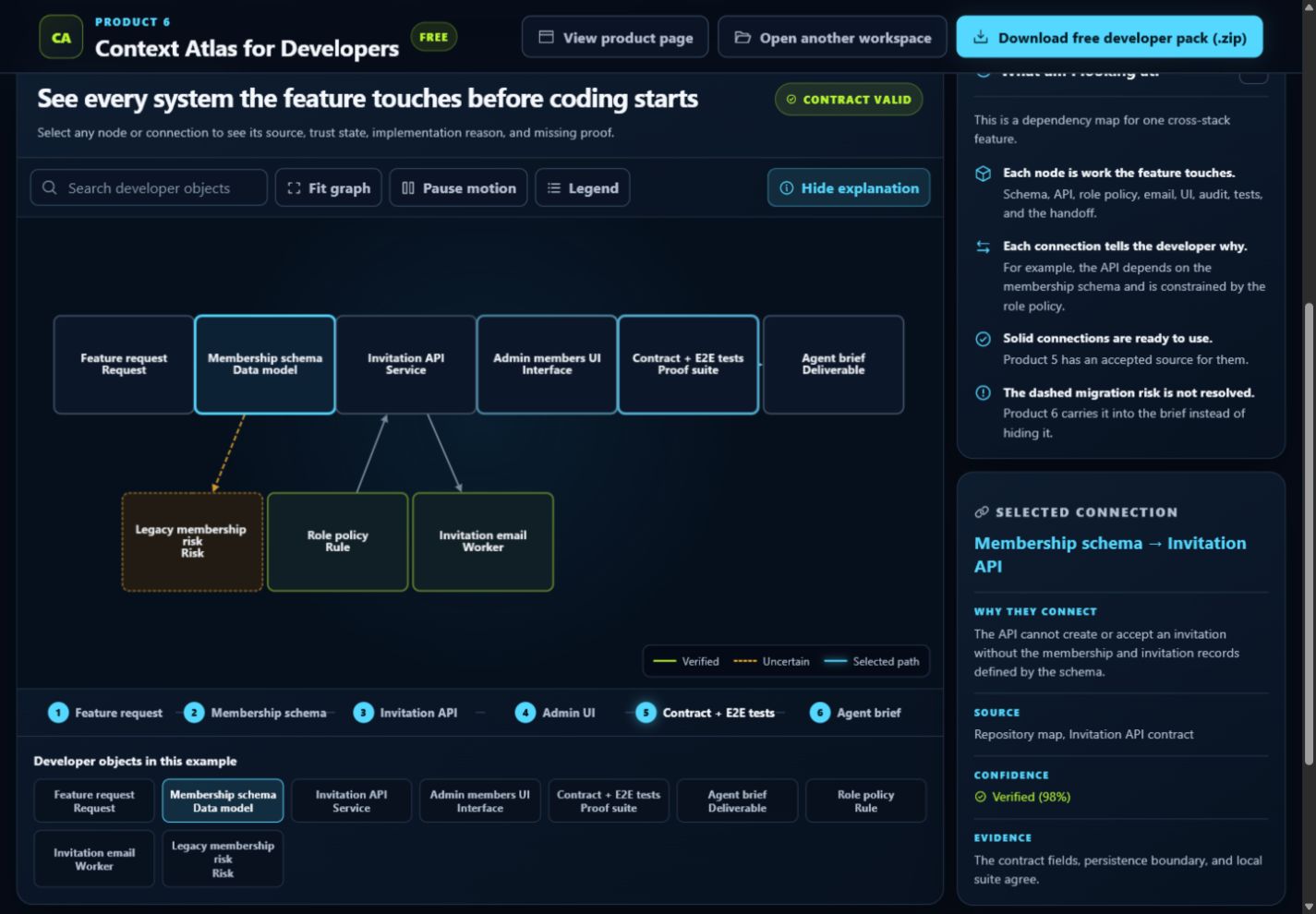
Team invitations look simple in a ticket but touch data, permissions, email, UI, audit events and tests. The graph prevents a developer or coding agent from treating the API endpoint as the whole feature.
Product 5 + Product 6 workflow
The developer pack carries reviewed truth into implementation. Test and migration results come back as proposed evidence—not automatic truth.
Accept the feature brief and role policy; keep the legacy migration gap uncertain.
Map the task across membership data, invitation API, role policy, email, admin UI, audit and tests.
Give the developer or coding agent allowed paths, security guardrails, forbidden actions and exact proof.
Propose test receipts and migration results for human review before project truth changes.
Portable by capability
Compatibility language is intentionally exact: mapped architecture is not presented as live acceptance.
The Version 0.1 developer example validates against the shared schema with no dangling references.
Context packets are runtime-neutral. Acceptance for each named agent remains a separate test.
Nodes, edges, sources and trust states can be adapted to graph-capable tools. Named integrations are not certified yet.
ChaseOS can consume the same governed context contract, but this edition does not require ChaseOS.
Interactive product preview
Choose a guided step, then click the preview itself to open the complete working Product 6 workspace. Use the secondary still-image control only when you want to inspect one frame.
Questions before the preview
No. The core contract is agent-neutral. Runtime adapters are separate, testable compatibility layers.
No by default. The product defines context packets and source references. Data movement remains an explicit operator choice.
Product 5 is where the team reviews the source records and trust states. Product 6 should not invent project truth; it selects reviewed records for one task and returns new evidence for review.
Yes as an optional governed integration path. ChaseOS is not required to use the neutral workspace and graph contract.
Need this operating knowledge applied to your own system?
See ChaseInTech services →No matches