ChaseInTech Digest
Gemini 4 Argon leads key coding and knowledge-work benchmarks
Google DeepMind's new model leads several headline evaluations and raises the output limit to one million tokens. The results are strong, but the full comparison is more useful than a claim that it wins at everything.
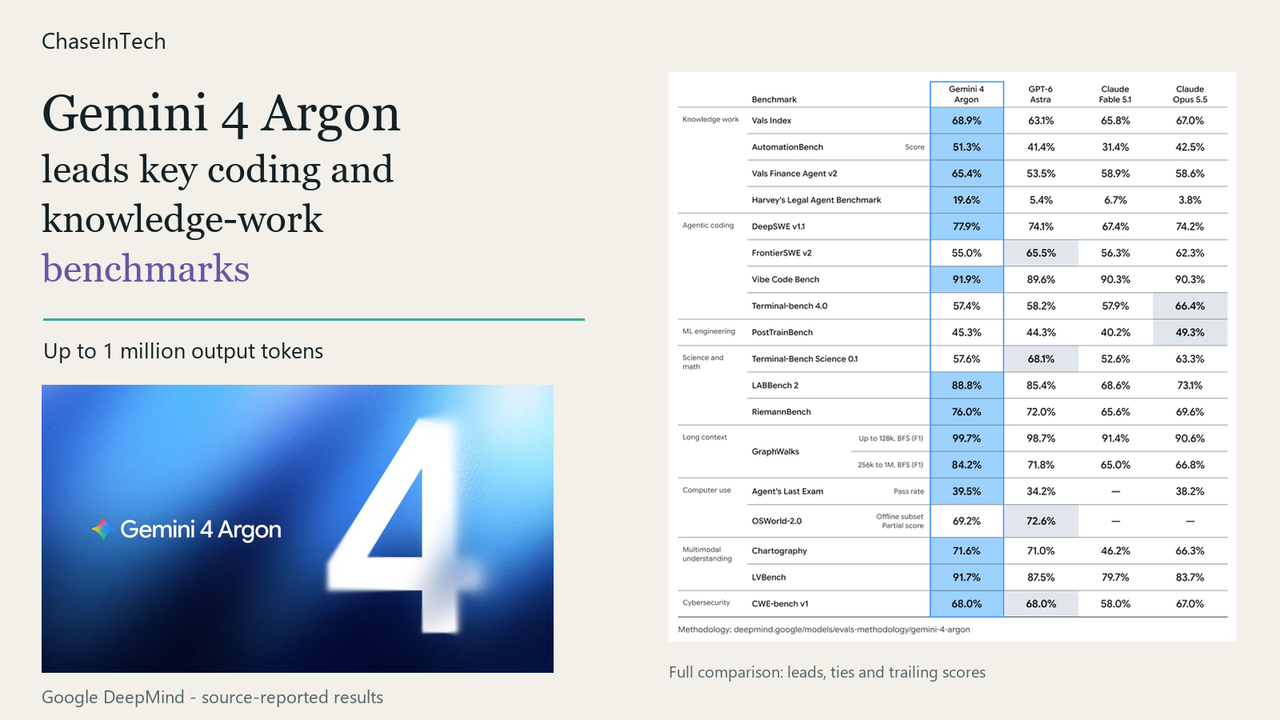
Google DeepMind announced Gemini 4 Argon on September 30, 2026. In Google’s published comparison, it leads the listed competitors on DeepSWE v1.1 and all four knowledge-work evaluations. It also has an output limit of up to one million tokens, increased from the previous 64K limit.
The benchmark results deserve to lead this story. The output budget helps explain the kind of sustained work Google is targeting.
Where Argon leads
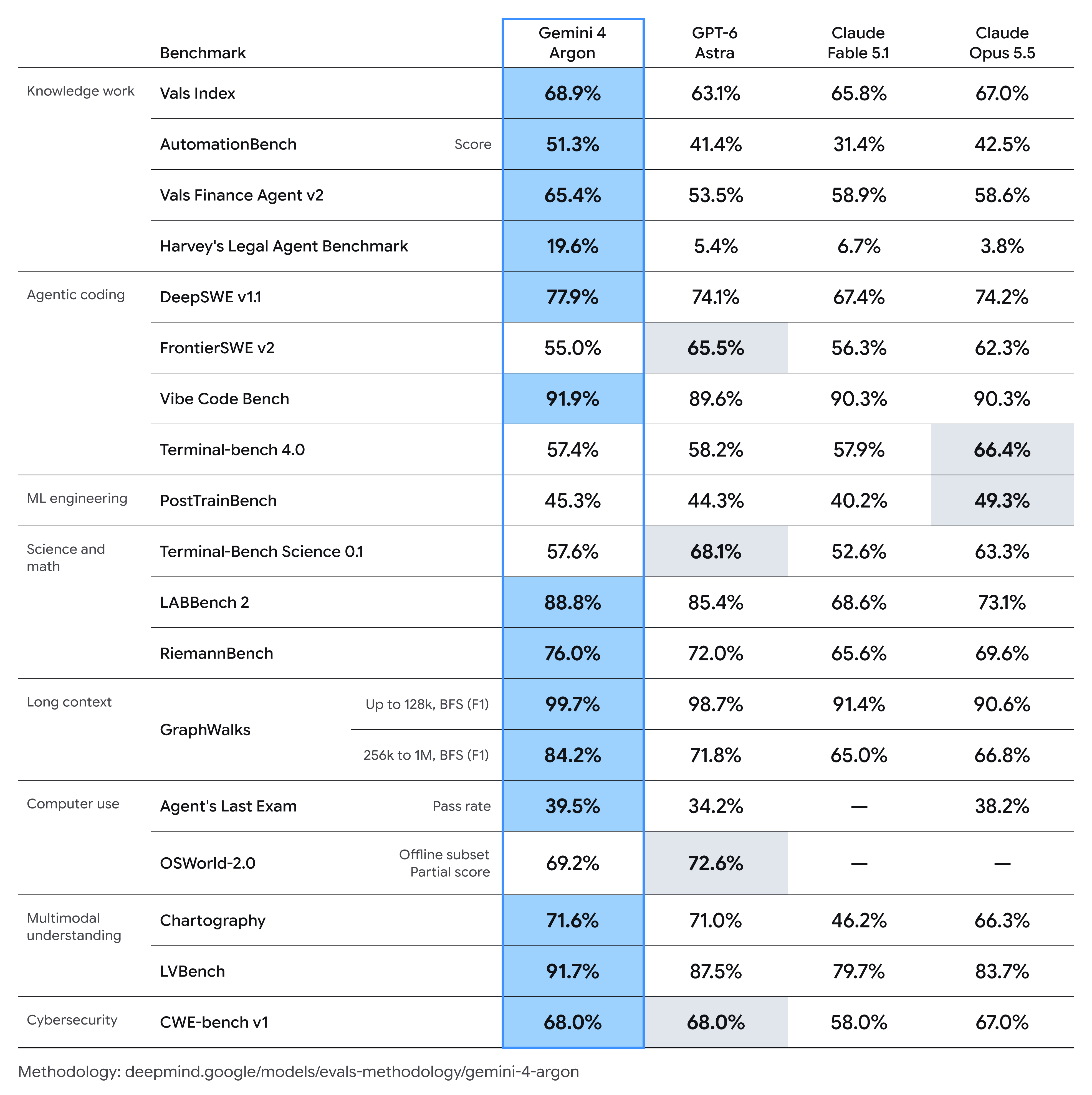
Google’s original published comparison. Scores are provider-reported under the stated evaluation conditions, not independently reproduced here. Original announcement and evaluation methodology. Select the table to view the full-size source image.
Google reports a DeepSWE v1.1 score of 77.9%, ahead of GPT-6 Astra at 74.1%, Claude Fable 5.1 at 67.4% and Claude Opus 5.5 at 74.2%. DeepSWE measures long-horizon software engineering, so this is a relevant result for people building agents that need to work through more than a short coding prompt.
The knowledge-work results are also strong. Google’s comparison lists Argon at:
- 68.9% on Vals Index.
- 51.3% on AutomationBench.
- 65.4% on Vals Finance Agent v2.
- 19.6% on Harvey’s Legal Agent Benchmark.
Argon leads the other models shown on each of those four rows. Google describes Vals Index as covering finance, coding, legal and tax work, weighted by each sector’s contribution to U.S. GDP. AutomationBench measures execution across business functions, while the finance and legal evaluations examine more specialised work.
These are benchmark-specific results. A 19.6% legal benchmark score is not a claim that Argon can replace a lawyer, and a coding score does not establish that every generated change is safe to ship.
The table also shows where competitors lead
Argon is not first on every evaluation.
On FrontierSWE v2, Google lists Argon at 55.0%, behind GPT-6 Astra at 65.5% and Claude Opus 5.5 at 62.3%. On Terminal-Bench 4.0, Argon scores 57.4%, while Opus 5.5 leads at 66.4%. Google’s table also shows Argon tied with Astra at 68.0% on CWE-bench v1.
That is why I would describe this as a lead on key coding and knowledge-work benchmarks, rather than a clean sweep. Different tests expose different strengths.
Google’s evaluation methodology matters here. It says Argon scores are pass @1 unless otherwise noted, with the highest thinking settings used unless indicated otherwise. Results for other models are provider self-reports except where stated, and some evaluations use external benchmark sources. This is a published comparison with stated conditions, not my own independently reproduced test.
A million output tokens, not a new input-window claim
Google explicitly announces an output limit of one million tokens. That gives the model more generation headroom for reasoning and producing work in a single trajectory. It should not be relabelled as a newly announced one-million-token input context window.
For a software agent, that extra room could help with a task that involves inspecting a repository, changing several files and responding to failed tests. It does not guarantee the agent uses the budget well, or that an application supports an uninterrupted run of that length.
Google’s own engineering examples are more useful than imagining a million-token chatbot essay. The announcement describes Argon agents working on C and C++ migrations to Rust, including work involving the Fuchsia Zircon kernel. Google says these large rewrites are undergoing automated and manual auditing, emulation testing and review before production rollout.
That qualification matters. Google is describing substantial engineering work with a verification process, not asking readers to trust a large generated diff without checking it.
Access and pricing
The initial rollout is to trusted cyber defenders through Google’s Fairwind Program. Google says broader release will start with paid API customers and Google AI Ultra subscribers, but the announcement does not give a public release date.
Announced introductory API pricing is $2 per million input tokens and $10 per million output tokens. After the introductory period, Google says those rates become $4 and $20 respectively. It also announces a 95% discount for cached input tokens. Published prices do not mean the model is generally available today.
What I would test before changing my stack
I would use Arena.ai as another comparison surface, alongside the original benchmark sources. I would keep those results separate: user preference, business-task performance and software engineering tests do not measure the same thing.
For my own systems, I would compare Argon with an existing model on the same bounded task, with the same tools and acceptance criteria. I would record whether the work passed independent checks, how much intervention it needed, elapsed time and total cost.
Argon’s published results make it worth evaluating for sustained coding and knowledge work. I would choose where to use it from those practical tests, rather than assume that a larger output budget or a headline benchmark lead settles every routing decision.