ChaseInTech Digest
GPT-6.1 Sol's real pitch: near-Astra results without an Astra-sized bill
OpenAI's GPT-6.1 Sol offers near-Astra results on selected benchmarks. Read its DeepSWE cost-per-task graph, exact token prices, and limits before routing agents.
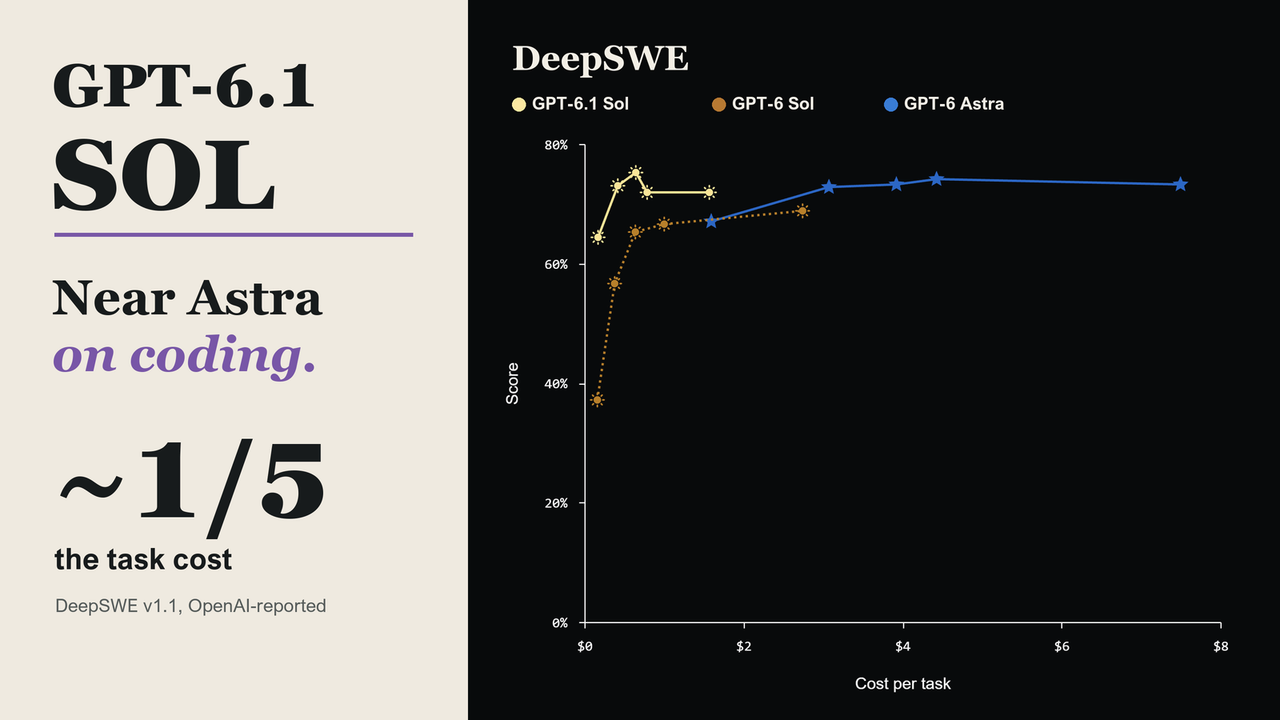
OpenAI has introduced GPT-6.1 Sol with a clear commercial argument: near-Astra capability at a far lower price. Its standard API rates are $2 per million input tokens and $10 per million output tokens, compared with GPT-6 Astra’s $10 and $50. Cached input is $0.10 per million tokens for Sol. Those are token prices, not a universal promise that every completed task costs exactly one-fifth as much.
That distinction matters. An agent can use more tokens, call more tools, retry a failed step, or require a human to clean up an answer. The cheapest request is not necessarily the cheapest finished job. OpenAI’s own launch makes the more useful comparison in several places: benchmark score against estimated cost per task.
What the official graph actually shows
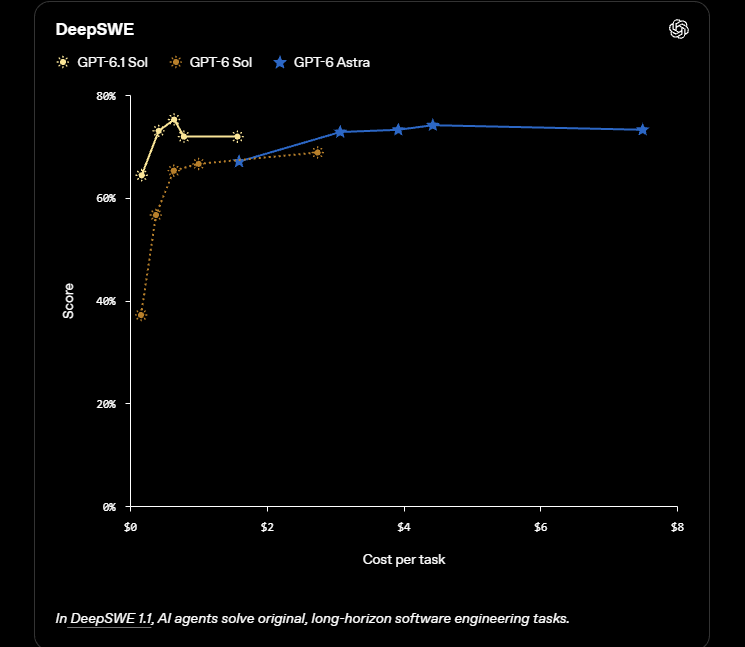
Figure: OpenAI’s original DeepSWE v1.1 comparison, captured from its GPT-6.1 Sol announcement. Horizontal axis: estimated cost per task in US dollars. Vertical axis: benchmark score. These are OpenAI-reported evaluation results, not independent measurements of a production deployment. View the original chart and methodology context.
The chart is a frontier, not a ranking by model name. Each line traces different tested settings. GPT-6.1 Sol’s points sit near Astra’s best score while costing substantially less per task in the configurations shown. OpenAI says Sol matches Astra on DeepSWE v1.1 at roughly one-fifth the cost per task. It also says Sol exceeds GPT-6 Sol’s best score by 6.4 percentage points at a lower reasoning effort and cost. DeepSWE tests agents on original, long-horizon software-engineering tasks; it does not certify that one model will match another on every repository, harness or review standard.
The same shape appears elsewhere, but the ratios change with the task. On GDP.pdf, a benchmark for questions about complex professional PDFs, OpenAI says Sol approaches Astra’s performance at roughly one-fifth the cost per task. On OSWorld 2.0’s offline set, Sol comes within 2.1 percentage points of Astra at maximum reasoning effort at roughly one-seventh the cost per task. That one-seventh figure belongs to this specific computer-use comparison; it should not be turned into a blanket pricing claim.
On Terminal-Bench Science 0.1, OpenAI reports an average of $5.47 per task for GPT-6.1 Sol at maximum effort, versus $23.80 for Astra. Astra still posts the highest score among the tested models there, at 68.1%. If you are paying for a difficult scientific workflow where the last increment of success matters, the more expensive model may still be rational. The launch is not evidence that Astra has become redundant.
Price is a routing decision, not a slogan
For an agent builder, the practical move is to stop treating the model picker as one global setting. A bounded workflow could begin on Sol for routine code changes, document extraction or computer-use tasks, then escalate when a verifier detects a failed test, an unsupported claim or an unresolved high-stakes decision. Astra remains the candidate for the hardest cases. That is an evaluation pattern, not a claim that ChaseOS or another product already ships this routing.
The comparison needs a common task contract. Give each model the same repository snapshot or document set, tools, timeout, stopping rule and acceptance test. Measure successful completions, median and tail latency, token spend, tool spend, retries, fallback frequency and human-review time. Calculate cost per accepted result rather than cost per call. If a cheaper first pass creates enough repair work, the headline discount can vanish. If it passes the same gate reliably, the margin is real.
Reasoning effort also changes the trade-off. The DeepSWE plot contains multiple points per model precisely because cost and score shift with configuration. A single dot picked to flatter either model would hide that curve. The question is not simply “Sol or Astra?” It is “Which model and effort setting clears this workflow’s quality threshold at the lowest total operating cost?”
Cached input deserves separate attention. OpenAI lists Sol’s cached input at $0.10 per million tokens, 95% below its standard input rate. That can matter for agents that repeatedly reuse long instructions or context, but only if requests actually qualify for caching. Do not apply the cached rate to all input by default. Track cache-hit share alongside output volume and retry rate before projecting a monthly bill.
What the release does not prove
These are vendor-reported benchmarks under particular research or API configurations. OpenAI notes that production ChatGPT behavior can differ because system prompts, tools and effort settings differ. The chart is valuable evidence of a model trade-off, not a guarantee of production performance or an independent audit. It says nothing by itself about your data permissions, tool safety, observability or whether an agent’s final artifact is correct.
OpenAI also reports lower factual-error incidence than GPT-6 Sol on a deliberately difficult set of de-identified, user-flagged conversations. The largest stated improvement is at low effort: from 11.4% of responses containing a factual error to 7.7%. That set is not representative of typical usage. It should motivate local evaluation, not replace it.
Availability has a boundary too: OpenAI says GPT-6.1 Sol is available in ChatGPT Work and Codex for Plus, Pro, Business, Enterprise and Edu users, and via the API as gpt-6.1-sol; the announcement says it is not yet available in Chat. Product surfaces and entitlements can change, so check the live model catalog before committing a customer-facing route.
The builder’s takeaway
OpenAI’s chart makes a serious case for trying GPT-6.1 Sol as the default candidate on work where Astra-level spend was previously hard to justify. It does not license an unqualified “same performance for one-fifth the cost” claim. The fifth is the standard token-price ratio and an approximate result on selected tasks; the seventh is a particular OSWorld cost-per-task result. Both need their denominator attached.
The next step is a small, reproducible bake-off on your own accepted outputs. Keep the harness fixed, make escalation explicit, log the route and the receipt, and inspect the failures. If Sol clears your bar, route more work to it. If it does not, pay for the stronger model where the difference buys a better finished result.
Sources
- OpenAI, “Introducing GPT-6.1 Sol” - launch claims, DeepSWE graph, benchmark definitions, prices, availability and evaluation caveats.
- OpenAI, GPT-6.1 Sol system card - safety and evaluation context.
- OpenAI API pricing - current model-rate reference; recheck before publication.