ChaseInTech Digest
GPT-6 Astra Rumours Are Outrunning the Evidence
Reported outputs are circulating under an Astra codename, but OpenAI has not published a GPT-6 model page, API identity, price or system card. This is a rumor audit, not a release announcement.
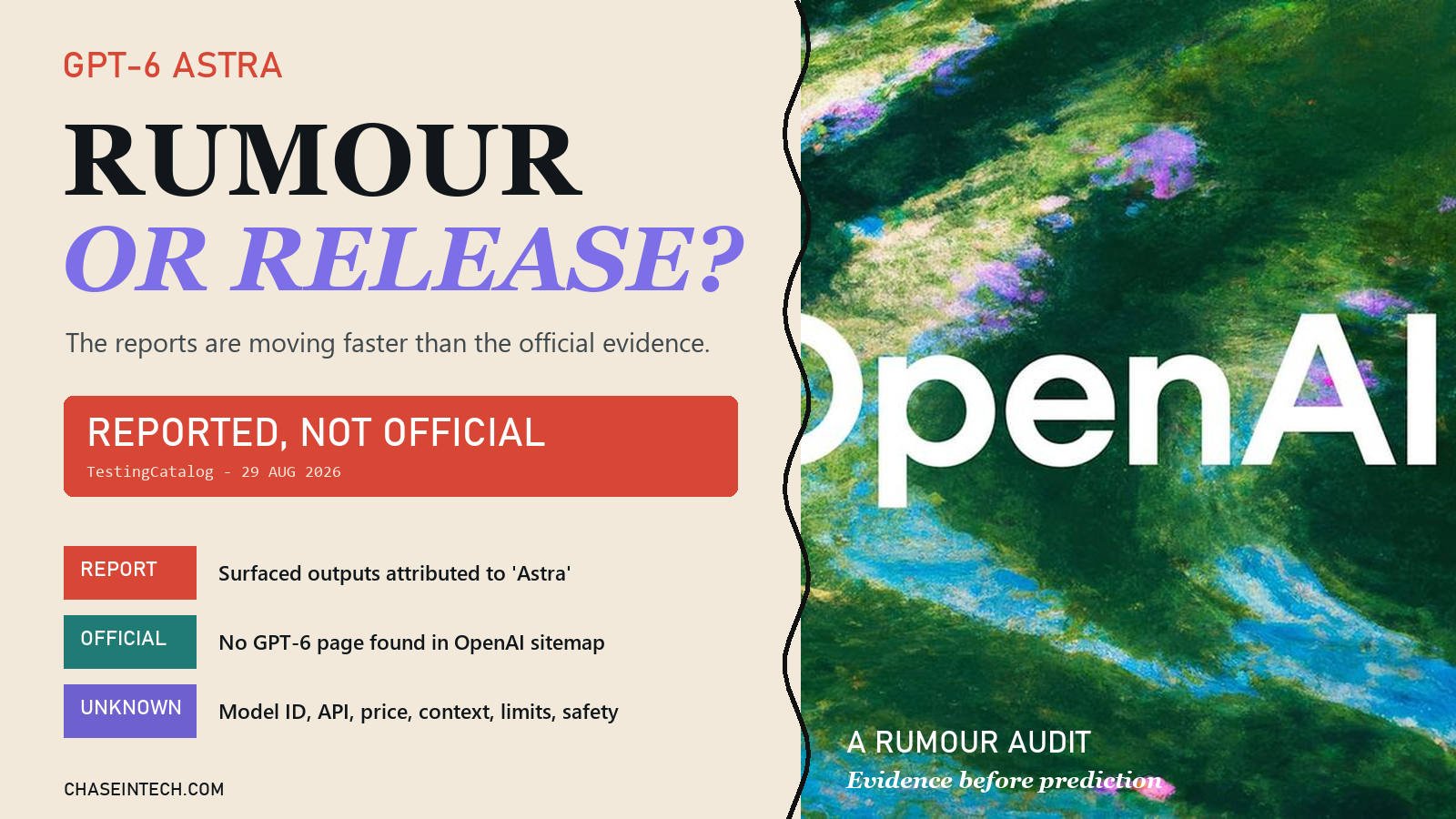
GPT-6 is already being discussed like a product launch. It is not one yet.
A third-party report published on 29 August attributes surfaced outputs to an OpenAI codename, “Astra.” The screenshots and commentary are interesting. They may even turn out to be early evidence of a future model. They are not an API identity, model card, price sheet or release note.[1]
I follow rumors because waiting for a polished launch page can leave a builder behind. I also refuse to plan a product around a codename that a vendor has not confirmed.
Both positions can be true. You can pay attention without pretending the evidence is stronger than it is.
This article separates the current GPT-6 story into four lanes: reported, observed, official and unknown.
Reported: outputs are being attributed to Astra
TestingCatalog published “First outputs from GPT-6 ‘Astra’ model from OpenAI” on 29 August. The page categorises the story under AI rumours and describes the outputs as reportedly generated with extended reasoning.[1]
That wording matters.
“Reportedly” means the publication is passing on an attribution. It does not mean OpenAI has confirmed the model identity. The output may come from an internal test, a limited evaluation route, a future product checkpoint or something else entirely. An outside reader cannot resolve that from the screenshot alone.
The report is a useful lead. It is not a release contract.
A release contract would include a stable model name, access route, documentation, pricing, limits and support boundaries. None of those are established by the existence of a surfaced output.
Observed: screenshots can show behavior, not product identity
A screenshot may show an interface, a response and a label. It can help answer narrow questions:
- Was this output presented under the name Astra?
- What kind of prompt appears to have been used?
- How long did the visible run take?
- Did the result contain code, analysis or tool output?
It cannot establish the whole product behind the image.
A label can be an internal alias. A response can be selected from many attempts. A timing figure can exclude queueing, retries or hidden work. A result can look strong without revealing the model version, system prompt, tool access or evaluation conditions.
This is the same reason I do not treat a vendor benchmark chart as production reliability. The visible result is one part of the harness.
For GPT-6 rumors, the harness is mostly missing.
Official: OpenAI has published GPT-5.6 pages, not GPT-6
I checked OpenAI’s live sitemap on 31 August. It contains first-party GPT-5.6 surfaces, including an official page for GPT-5.6 in Kiro. I did not find a GPT-6 model page, GPT-6 announcement, Astra model page or Bel model page in that sitemap.[2][3]
This is a bounded negative finding.
A missing sitemap entry does not prove that OpenAI has no internal model, checkpoint or experiment with those names. It only proves that the first-party publication surface I checked did not expose the product documentation a developer would need.
That is enough to reject one claim: GPT-6 has not been verified as a public product through the official surface used in this audit.
It is not enough to claim that every rumor is false.
Unknown: the details that determine whether builders can use it
Most of the useful questions remain unanswered.
Model and API identity
What exact identifier would a developer send? Would GPT-6 be one model, a family or a routing layer? Would Astra survive as a public name?
Without a stable identifier, there is nothing to integrate or test.
Price
A model can look excellent in a screenshot and still be a poor fit for repeated agent work if output tokens, tool calls, cache behavior or long reasoning make the successful task expensive.
The rate card is only the start. I would still measure cost per successful, checked task.
Context and state
A context-window number does not tell us how well the model uses long repositories, whether it compacts state, how it preserves instructions or what happens after repeated tool calls.
The practical question is how much useful state survives the workflow.
Tool use
Does the model call tools directly? Can it work through Codex or another managed harness? How are permissions represented? Can results be inspected before the model reuses them?
A stronger model with weak tool boundaries can increase the blast radius of an error.
Availability and limits
Who gets access? Which regions, plans and APIs? What are the rate limits? Is the model suitable for background work or only interactive sessions?
A demo that cannot be scheduled or budgeted is not an agent platform.
Evaluation method
If new benchmark results appear, I want the exact benchmark version, harness, settings, number of trials, grader and failure treatment.
A number without the run contract is advertising material, not operating evidence.
Safety documentation
A public system card or equivalent document should define the tested risk areas, deployment restrictions and known limitations. It will not prove the system is safe, but it gives outside reviewers something concrete to examine.
Parameter counts are not a substitute for evidence
Some GPT-6 coverage has repeated very large parameter-count claims. I am not treating those figures as facts.
Parameter counts can be misunderstood even when the vendor publishes them. Total parameters, active parameters, expert routing and inference cost are different quantities. A speculative number tells us almost nothing about the cost or reliability of a real task.
The same applies to predictions that a model will arrive within days. A market price, anonymous comment or social post can measure expectation. It cannot set OpenAI’s release schedule.
If OpenAI publishes the model tomorrow, the evidence changes tomorrow. The correct response is to update the article, not pretend today’s rumor was official all along.
How I handle rumors in a real product workflow
I use a simple rule.
A rumor can enter research. It cannot enter production routing.
That means I can:
- save the source;
- record the date and exact wording;
- identify testable claims;
- prepare a provisional evaluation plan;
- watch the first-party documentation surfaces.
I will not:
- add an unverified model to a live registry;
- promise a customer that a rumored capability is coming;
- publish a price or release date without a first-party source;
- build a governance claim around a codename;
- present a screenshot as a system card.
This keeps the research lane fast without contaminating product truth.
What would change this article
A first-party OpenAI announcement would move part of the story from reported to official.
The minimum useful publication would include:
- exact model or family name;
- API or product availability;
- price and rate limits;
- context and tool-use documentation;
- evaluation details;
- safety or system documentation;
- migration guidance from current models.
Once those exist, the article should stop asking whether GPT-6 is a release. It should test whether the release does what the documentation claims.
Until then, the honest headline has a question mark.
Sources
[1] https://www.testingcatalog.com/first-outputs-from-gpt-6-astra-model-from-openai - TestingCatalog: reported GPT-6 Astra outputs [2] https://openai.com/sitemap.xml - OpenAI sitemap [3] https://openai.com/index/gpt-5-6-in-kiro - OpenAI: GPT-5.6 in Kiro