ChaseInTech Digest
Anthropic Wants AI Agents to Operate Lab Hardware
The Model Hardware Standard research preview connects agents to microscopes, liquid handlers and robotic arms. The difficult part is bounding physical authority and proving what changed.
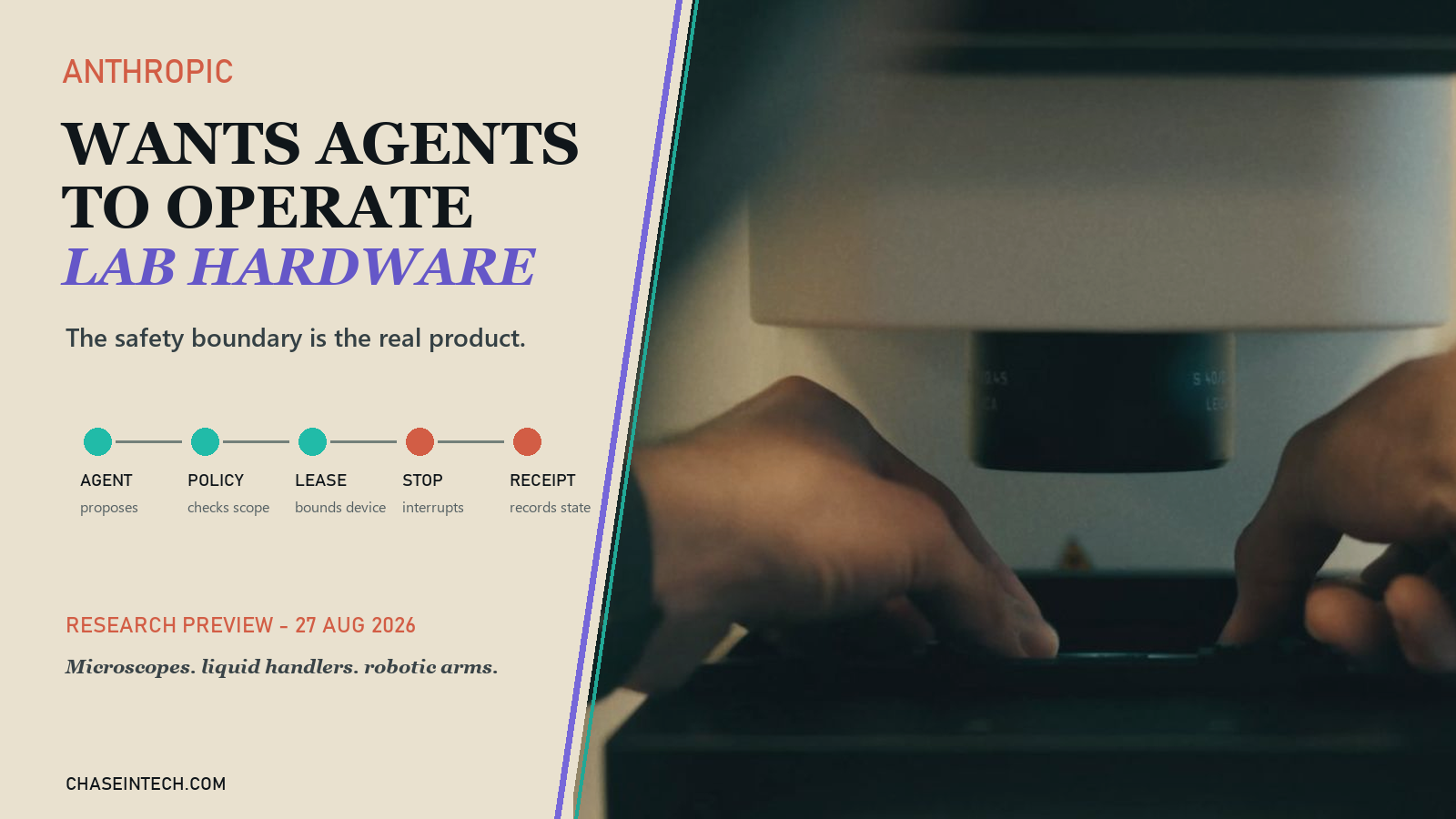
An AI agent editing the wrong file can break a build. An agent operating a microscope, liquid handler or robotic arm can change the physical world.
Anthropic opened a research preview of the Model Hardware Standard on 27 August. MHS is described as a shared specification for agents to operate devices from different manufacturers. The launch examples include scientific and manufacturing equipment, and Anthropic names Hugging Face LeRobot and Raspberry Pi among the early adopters.[1]
The shared interface is useful. The harder problem sits around it.
Which device is the agent talking to? What exact action is allowed? How far can a motor move? What happens when two devices need the same resource? Who can stop the run? What evidence proves the device reached the expected state?
Once software can produce physical side effects, those questions are part of the product.
A common command format does not create common safety
Laboratory and manufacturing equipment often comes from different vendors, with different interfaces, timing rules and failure behavior. A shared specification can make coordination easier because the agent does not need a separate ad hoc integration for every device.
That removes friction. It can also concentrate authority.
An agent that previously controlled one instrument through a narrow script may now have a route to several instruments through one standard. The interface becomes easier to use, and the blast radius of a bad instruction can grow at the same time.
This does not make the standard a bad idea. It means the safety model cannot stop at protocol compatibility.
A device may accept the same shape of command while requiring completely different operating limits. A microscope stage, liquid handler and robotic arm do not share the same consequences, even if one agent can address all three.
The control plane must understand the device, action and physical context behind the call.
Device identity has to be stronger than a friendly name
A physical workflow needs a verified device identity.
“Microscope 2” is not enough if the operator cannot prove which hardware instance, firmware, calibration state and attached components sit behind that label.
The task contract should bind to a specific device record. That record should include the properties that matter for safe operation:
- manufacturer and model;
- unique device identity;
- firmware and driver version;
- calibration or maintenance state;
- attached tools or consumables;
- physical location;
- supported safety interlocks.
The agent should not silently substitute a different device because the preferred one is unavailable. Substitution changes the task.
If the operator approves one microscope and the runtime routes to another, the approval no longer describes what happened.
Capability leases should expire with the task
I would not give a hardware agent a standing permission such as “can control robotic arms.”
I would issue a short capability lease tied to one task.
The lease would define:
- the exact device;
- allowed commands;
- bounded operating range;
- maximum force, speed, temperature or volume where relevant;
- start and expiry time;
- maximum number of actions;
- required sensor conditions;
- actions that trigger fresh human approval.
A task that needs to move one stage by a small distance should not inherit permission to run every motion function on the device.
The lease should also die when the task closes, fails or loses contact with the supervising system. An unattended session must not leave durable hardware authority behind.
Timing and concurrency are part of the safety model
Physical work happens over time.
A command can be valid in isolation and dangerous in sequence. A liquid handler may need to wait for a plate to reach the correct position. A robotic arm may need an area to remain clear. A microscope may need the sample to stop moving before capture.
When one agent coordinates several devices, it must handle dependencies, resource locks and timeouts. It also needs a defined response when the physical state does not match the expected state.
Retrying the same command is not always safe.
In software, a retry might create a duplicate record. In hardware, a retry might repeat a dose, move a stage twice or apply force again. The system should treat every retry as a new physical decision unless the device can prove that the first action did not occur.
Idempotency cannot be assumed. It has to be designed into the device operation or established from sensor evidence.
Interlocks must sit below the model
A language model should not be the last safety check before motion.
Hard limits and emergency stops need to exist below the reasoning layer. The model may propose an action, but the device controller or independent safety layer should enforce boundaries the model cannot override.
That includes:
- travel limits;
- collision zones;
- force and speed ceilings;
- temperature and pressure constraints;
- door, cover or enclosure state;
- presence sensors;
- emergency-stop state.
The model can explain why it wants an action. It should not be able to argue a physical interlock out of the way.
A useful architecture separates proposal from authority:
- The agent proposes a device action.
- The policy layer checks the task and capability lease.
- The safety controller checks current physical conditions.
- The device executes within hard limits.
- Sensors confirm the resulting state.
- The system records the receipt.
If any layer cannot prove its preconditions, the action should stop.
Human approval needs an exact physical target
A generic confirmation such as “Allow this experiment?” is weak approval.
The review should show the operator:
- the device and current state;
- the proposed action and operating range;
- the reason for the action;
- expected physical result;
- known hazards or irreversible effects;
- what the system will measure afterward;
- how to stop or recover.
The approval should bind one person to one action scope and expire if the device state changes before execution.
If the sample moved, the tool changed or the calibration expired, the old approval should not carry forward automatically.
Physical state needs a receipt
Software agents often close a task when a command returns success. That is not enough for physical work.
A controller can acknowledge a command without proving the real-world outcome. The arm may stall. The liquid transfer may be incomplete. The image may be captured from the wrong position.
The receipt should include both the command and the observed result.
Depending on the device, that might mean:
- encoder position;
- sensor reading;
- before-and-after image;
- measured volume or weight;
- timestamped controller status;
- interlock state;
- operator intervention;
- error and recovery path.
The evidence does not guarantee scientific validity. It proves more narrowly what the system observed during the action.
That distinction matters. A correct device movement can still produce a bad experiment. The agent-control receipt and the scientific conclusion are separate layers of evidence.
The research preview is not a safety certificate
Anthropic says the MHS research preview will help build additional safety evaluations and strengthen protections for AI use in the physical world. The company also says it is developing a physical safety roadmap.[1]
That is a statement of work in progress.
The announcement does not establish general availability, field prevalence or proof that agents can safely run arbitrary laboratories. Early integrations show that the interface can be explored with real devices. They do not settle governance across every machine, environment and experiment.
The most useful response is not to dismiss the standard or celebrate it as solved. It is to test the boundaries while the specification is still being shaped.
What I would test before trusting a hardware agent
I would start with a simulator or a low-consequence device task and force the system through failure cases.
The test plan would include:
- wrong device identity;
- expired capability lease;
- stale calibration;
- unexpected sensor state;
- conflicting device schedules;
- partial physical completion;
- network loss during execution;
- duplicate command delivery;
- human stop during motion;
- recovery after a failed receipt.
I would also test the evidence path. Can an independent reviewer reconstruct which device moved, under which approval, within which bounds, and what sensors observed afterward?
If the answer is no, the system is not ready for unattended physical authority.
Where ChaseOS fits, and where it does not
ChaseOS does not currently claim a shipped MHS integration.
The relevant connection is architectural. ChaseOS already treats authority, approval and evidence as separate parts of agent work. A future physical-device lane would need to extend that model with device identity, short capability leases, interlocks, emergency stops and physical-state receipts.
That is a proposed direction, not product truth.
MHS makes the device interface easier to imagine. The operating system around it still decides whether an agent can use that interface safely.
The command format may be shared. Responsibility cannot be delegated to the format.
Sources
[1] https://www.anthropic.com/news/model-hardware-standard-research-preview - Anthropic: Previewing the Model Hardware Standard