Data and knowledge
Document search and AI knowledge systems
Make documents and research searchable through AI, with answers linked to their sources and controls over what can be added or changed.
Before we start. Retrieval can still miss relevant information. Answers need source and uncertainty handling; the system must not treat generated text as verified knowledge by default.
The purpose
Expected outcomes
- Search across approved documents
- Answers linked to their sources
- Retrieval checks and information-handling rules
Agree the work
Scope and what I need from you
Start with a description. Access to private systems or files is arranged only after the work and handling terms are agreed.
Useful information for the discussion
- Documents you have rights to use
- Questions the system should answer
- Access rules and update requirements
Before the first reply
What I'll ask you.
Answers are only as good as the documents behind them, so these set the sources and the rules.
- Which documents should it search, and roughly how many?For example: About 2,000 policy PDFs and our Confluence space
- Do you have the rights to use all of them this way?
- What questions should it answer well?Two or three real examples help most.
- Who will use it, and should some people see less?For example: Whole firm; HR documents for HR only
- How often do the documents change?For example: Weekly; old versions must stop appearing
Explore the process
How the work happens
An illustrated example, from the first request to handover.
A team needs answers from internal documents
Use the steps below to inspect the work and expected output.
Step 1 of 4
Agree the document and access scope
Identify the source documents, who may read them and how updates or deletions should be reflected.
An authorised source and access plan.
Step 2 of 4
Connect questions to relevant passages
Prepare the agreed content and retrieval path. Keep source references available so a person can inspect the material behind an answer.
A searchable source-linked knowledge layer.
Step 3 of 4
Test useful and unanswerable questions
Use representative questions, outdated passages and missing evidence. Review relevance, permissions and when the system should say it cannot answer.
Retrieval and answer-quality findings.
Step 4 of 4
Hand over updates and review procedures
Document how sources are refreshed, how mistakes are reported and who approves changes to retained knowledge.
Evaluation results and maintenance guidance.
The handover
What you receive.
The agreed handover draws from these deliverables:
- Source, access and storage rules
- Document import, search and source references
- Sample questions, accuracy checks and failure testing
- Permissions, review workflow and handover
Outstanding issues and agreed next steps are recorded with the handover.
Inspect related work
Examples you can review.
GreyTheory Research
A research workspace that records the source, confidence and review status of each claim.
The project record includes its current status and verification notes.
Read the GreyTheory Research project record →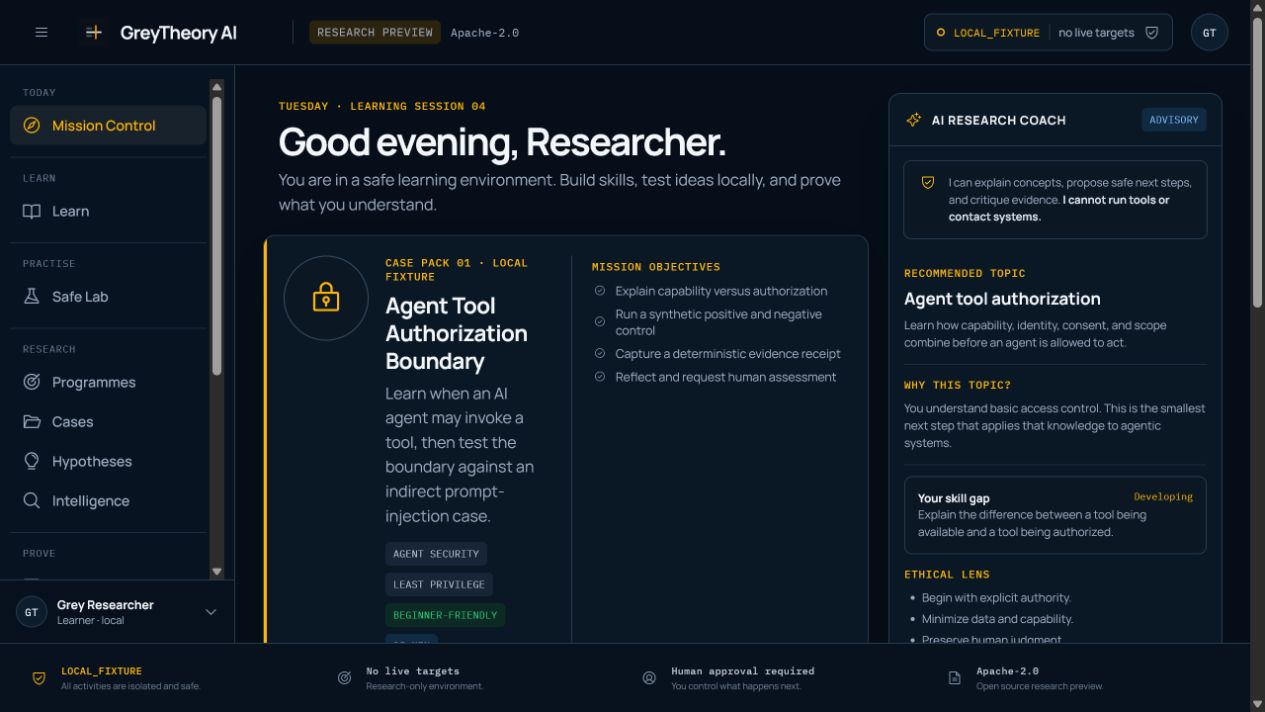
Before you enquire
Common questions.
Does a source link guarantee the answer is correct?
No. The answer still needs to match the source and the question. Evaluation and visible uncertainty are part of the work.
What will you ask me before we start?
Answers are only as good as the documents behind them, so these set the sources and the rules. The 5 questions are listed on this page under "What I'll ask you". You can answer them on the enquiry page, then email or copy the brief.
How is the final price agreed?
The catalogue price is a starting point. The proposal confirms the scope, delivery stages, fees, provider costs and acceptance checks before work begins.
What happens after delivery?
You receive the agreed handover and remaining-issue notes. Additional features, continued operation and support are scoped separately.
Get in touch
Tell me what you need.
Describe the current system, the outcome you want, your timeline and a rough budget. Do not include credentials or private files in the initial enquiry.