Free agent context and memory guide
Stop re-briefing your AI agents
A practical guide to context, durable project memory, working state, permissions and recovery—without pretending a saved chat is organisational truth.
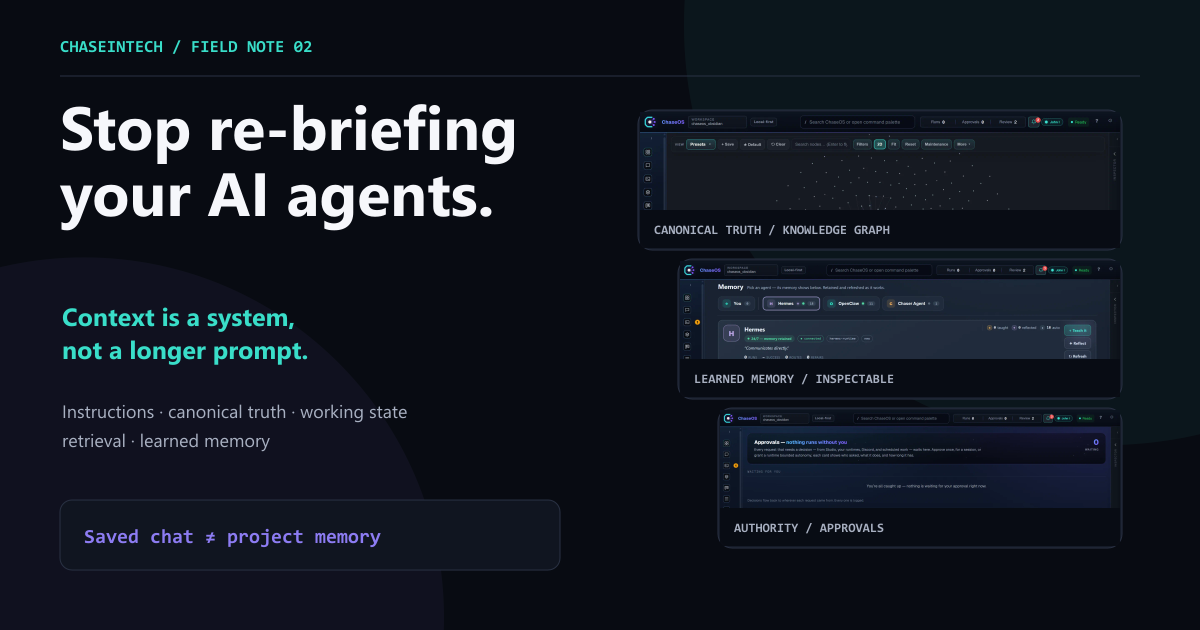
The useful distinction
A saved chat is not a complete project memory.
A saved conversation can preserve message history and still leave an agent without current project truth, recoverable working state, trustworthy retrieval or authority to change memory.
01
The problem is not one forgotten prompt
Re-briefing happens when stable rules, project facts, the active task, retrieved evidence and personal preferences are all packed into the same chat. Some history may survive, but the agent still cannot tell which fact is canonical, which decision is current, which source is trusted or what it is allowed to change.
A larger context window can hold more text. It does not automatically turn that text into governed project state. The useful design question is not ‘How do I paste everything?’ It is ‘What is the smallest current set this run needs, and where does each part belong?’
02
Memory is not one box
Conversation history, a task checkpoint, a knowledge base and a learned preference solve different problems. Combining them behind one ‘memory’ label makes failures hard to diagnose and corrections hard to govern.
- 01Instructions
Stable operating rules, role, tool guidance and non-negotiable boundaries.
- 02Canonical truth
The current project home, decisions, source files and explicit stale or unverified state.
- 03Working state
The active goal, plan, completed work, blockers, next action and definition of done.
- 04Retrieval
The smallest relevant evidence loaded with source, date and trust state attached.
- 05Learned memory
Preferences and reusable lessons that remain inspectable, correctable and removable.
03
Give the agent a map, not the whole vault
A project map should tell the agent where current truth lives and how to find deeper evidence when needed. Loading every document up front spends context on material that may be irrelevant, duplicated or stale.
Good retrieval keeps provenance visible. The agent should be able to distinguish an original source from a summary, an inference and an unverified note. When sources conflict, the system should stop or escalate instead of silently choosing the most convenient version.
04
Let memory read more than it writes
Automatic recall and automatic writeback are different authority levels. An agent may be allowed to search project knowledge while still needing review before changing canonical documents, saving a new long-term memory or acting outside the workspace.
Useful memory has an owner, a source, a timestamp, a correction path and a deletion path. Without those controls, persistent memory can preserve yesterday’s misunderstanding more efficiently than today’s truth.
05
Design the resume path before the long run
A durable agent workflow can explain what happens after interruption: which checkpoint resumes, what must be revalidated, which side effects may already have happened and what evidence proves the task is complete.
The final test is practical. Start a fresh session with no spoken recap. If the agent can locate the project, recover the current goal, name the next safe action and cite the sources behind its state, the system is carrying context instead of making the operator do it again.
This is evidence-led: choose an item only when you can point to the interface, test, deployment or handover evidence behind it. Your selections stay in this browser.
Instructions and boundaries
Canonical project truth
Recoverable working state
Retrieval and memory writeback
Recovery and evaluation
Why this guide exists