Free business-system decision guide
Not every business problem needs software
A practical guide for deciding whether a recurring business problem needs a workflow change, an assisted service, targeted automation, purpose-built software or more evidence first.
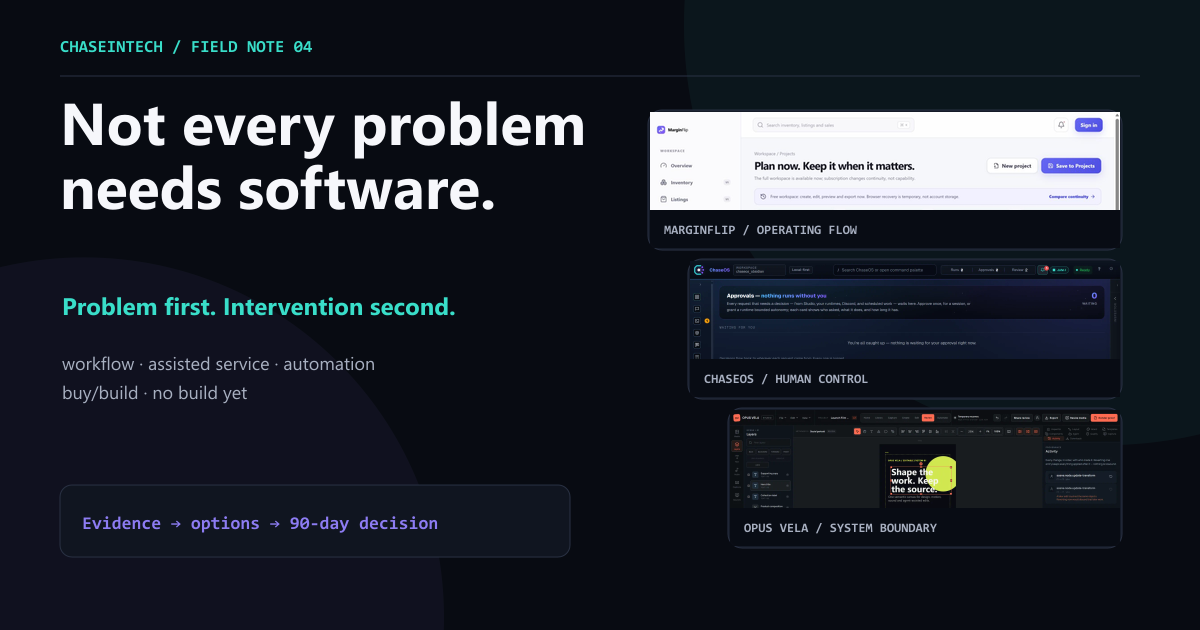
The useful distinction
A real problem is not automatically a software requirement.
Start with evidence of the problem and the current workflow, then compare several interventions against the same outcome. Software is one option—not the default—and a short manual pilot or a no-build decision can be the most useful next step.
01
Turn the proposed solution back into a problem
‘We need a dashboard’, ‘we should automate this’ and ‘there is an app opportunity here’ are proposed interventions. Restate each one as an observable problem: who encounters it, what they are trying to complete, what happens now, how often it occurs and what the failure costs in time, money, risk or experience.
Keep observed evidence separate from belief. Process records, support patterns, repeated manual work, interviews and direct observation can show that a problem exists. A feature request, competitor product or founder preference may be a useful lead, but it does not yet show which intervention will improve the outcome.
02
Map the current workflow before replacing it
Trace one real case from trigger to outcome, including handoffs, spreadsheets, inboxes, approvals, workarounds, exceptions and recovery. The map often reveals that the visible task is only one step in a larger service and that the expensive failure sits elsewhere.
Establish a baseline you can revisit: volume, time per case, waiting time, error or rework rate, support demand, operating cost, risk exposure and the quality of the user outcome. Use ranges when the data is incomplete and label assumptions rather than turning them into invented precision.
- 01Fix the workflow
Remove a step, clarify ownership or standardise the process before adding technology.
- 02Run an assisted service
Deliver the outcome manually long enough to learn where judgement and exceptions live.
- 03Add targeted automation
Automate one stable, repeated step while keeping human review where it matters.
- 04Buy or build software
Compare off-the-shelf and purpose-built options against the same needs and constraints.
- 05Do not build yet
Stop, observe or collect evidence when the problem, value or operating owner is not clear.
03
Compare interventions, including business as usual
Put at least three plausible routes beside the current state. A useful list might include a process change, an assisted service, a narrow automation, an off-the-shelf tool and a custom system. Judge each against the same critical outcomes, costs, dependencies, risks, accessibility needs, ownership and reversibility.
Treat ‘do nothing yet’ as a real comparator. Discovery has done its job when it supports a proportionate next decision—even when that decision is to stop, wait or solve the problem without new software.
04
Test the riskiest assumption with the smallest credible move
If the unknown is whether customers value the outcome, run an assisted pilot before automating delivery. If the unknown is integration or data quality, test that boundary. If a current tool may already be sufficient, configure and trial it before commissioning a replacement.
Define what the test should teach, the evidence you will collect, who owns the decision and the point at which you will continue, change direction or stop. A prototype is valuable when it reduces a named uncertainty, not because it looks like a smaller finished product.
05
Make a 90-day decision another person can inspect
Record the problem evidence, current workflow, options considered, decision criteria, recommended intervention, rejected routes, assumptions and an explicit 90-day action. Show what the action includes, what it does not include, what it will cost or consume, and what evidence will trigger the next decision.
A decision pack is not a guaranteed forecast or a substitute for legal, financial or regulated advice. Its value is an inspectable chain from evidence to recommendation, with enough diagrams, assumptions and handover material for the business to challenge the choice or commission the next phase without starting again.
This is evidence-led: choose an item only when you can point to the interface, test, deployment or handover evidence behind it. Your selections stay in this browser.
Problem evidence
Current workflow
Audience and market evidence
Intervention choice
90-day decision
Why this guide exists