ChaseInTech Builder Notes
Rebuilding a Reselling Business With Autonomous Agents - Part 4
A build log covering inventory, computer control, approval gates and the first eBay listing in my autonomous reselling workflow.
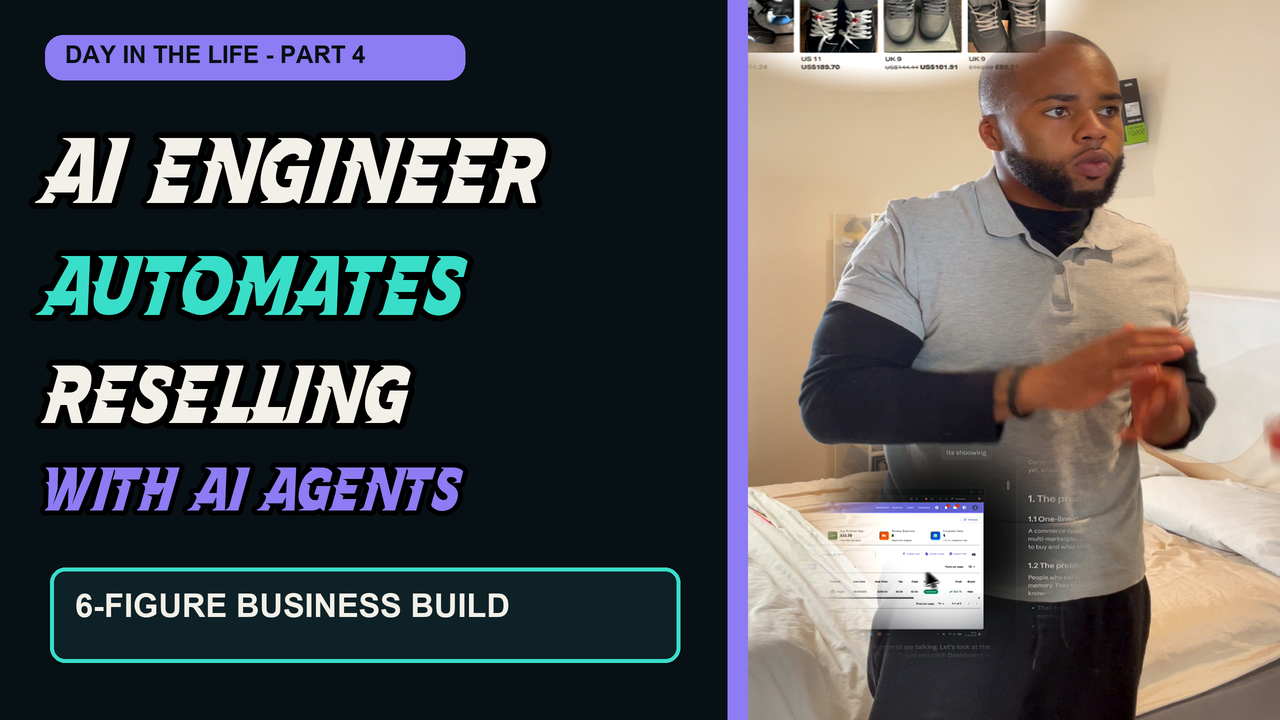
Part 4 moves the reselling build from plans and isolated tools into a real operating sequence: inspect inventory, prepare the listing, control the computer, keep the approval points visible and put the first product live on eBay.
I am rebuilding a reselling business around autonomous agents, but the goal is not to remove myself from every decision. The goal is to stop treating every repetitive action as a fresh manual task while keeping control over the decisions that carry commercial or account risk.
This instalment follows the workflow from physical stock to a public listing. It also shows why agentic commerce is harder than connecting a language model to a browser.
The workflow in Part 4
The build joins several different kinds of work:
- inspect and identify physical inventory;
- turn product evidence into structured listing data;
- prepare titles, descriptions and operational records;
- use computer control to move through the commerce interface;
- pause at the approval points that affect pricing, account actions or publication;
- verify that the intended listing actually reached the live state.
Each step can look simple in isolation. The real engineering challenge is preserving context and evidence as work passes between them.
A product image, an inventory record, a model-generated description and a browser action do not have the same authority. The system needs to know which inputs are evidence, which outputs are proposals and which actions require a human decision.
Why inventory is the difficult starting point
Reselling begins in the physical world. Stock can be incomplete, mislabelled, duplicated or stored under an old description. Condition is not a clean database field until someone has inspected the item and recorded it properly.
That makes inventory a poor place for blind automation.
An agent can help organise evidence, identify missing fields and prepare a draft. It should not quietly turn uncertainty into a confident product claim. The useful workflow keeps the original images and observations attached to the record, makes missing information visible and lets a human correct the item before anything public is submitted.
This is where MarginFlip fits into the wider system. It is the operational product layer for turning legacy stock into structured inventory and a repeatable resale workflow. ChaseOS provides the broader control-plane pattern: tasks, agents, evidence, approvals and durable state should remain inspectable instead of disappearing into one long chat.
Computer control is only one layer
The visible part of an autonomous workflow is often the cursor moving through a website. That is useful, but it is not the whole system.
Computer control needs a contract around it:
- the exact account and destination;
- the item being processed;
- the allowed actions;
- the data approved for entry;
- the points where execution must stop;
- the evidence required before completion can be claimed.
Without that structure, browser automation can move quickly while the business loses track of what it changed.
In this build, Hermes acts as the operating agent across the workflow while ChaseOS provides the governance direction around state, permissions and proof. Claude Code and Codex remain development lanes where appropriate. The important design choice is separation: the system that proposes work should not automatically gain unlimited authority to publish, price or modify an account.
The approval points stay human
The agents can move the workflow forward, but I retain the decisions that materially affect the business.
That includes:
- confirming that the item record matches the physical product;
- reviewing condition and disclosure language;
- approving pricing decisions;
- authorising account-level actions;
- approving publication;
- checking the live destination rather than trusting a completion message.
This is not a ceremonial “human in the loop” label. An approval is useful only when the person can see the proposed action, the evidence behind it and the consequence of accepting it.
The objective is to make each approval smaller and better informed. I should not have to reconstruct the entire job every time the system asks for a decision.
The first eBay listing is a systems milestone
Putting one product live is not proof that the complete reselling operation is autonomous or commercially successful.
It is still an important milestone because it exercises the full path across inventory, data preparation, computer control, approval and public verification. A working end-to-end path exposes problems that isolated demos hide:
- incomplete source data;
- inconsistent product naming;
- unclear authority boundaries;
- fragile browser steps;
- missing receipts;
- completion claims that do not match the public state.
The next stage is to make that path repeatable across more inventory without weakening the review gates. The useful operating metric is not how many prompts the agents produce. It is how many listings reach an accepted, verified state with a clear record of what happened.
Turning the build into a public operating log
The final Part 4 video was edited in CapCut and exported as a privacy-safe 4 minute 11 second master. Private working material was treated before publication, and the public cut keeps the focus on the workflow rather than exposing the underlying operating channels.
Publishing the build log is part of the engineering discipline. It creates a durable record of what the system could do at this point in time, what remained human-controlled and what still needs to improve.
Watch Part 4
Watch Day in the Life of an AI Engineer - Part 4 on YouTube.
The same build is also available through the verified X post and LinkedIn post.
What I am building toward
The longer-term target is not a bot that can click “List item.” It is an inspectable operating system for a reselling business:
- physical inventory becomes structured evidence;
- agents prepare and coordinate bounded work;
- deterministic checks handle what can be proven exactly;
- human approvals protect commercial and account decisions;
- public actions return receipts;
- failures can be corrected without losing the workflow state.
That is the standard I am applying to MarginFlip, ChaseOS and the wider autonomous-agent stack: useful autonomy, visible boundaries and proof that the intended outcome actually happened.